Archiv Blu-Ray Reviews

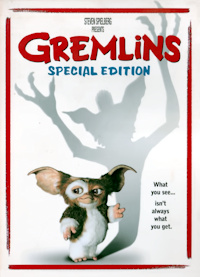
Blu-Ray Review: Gremlins

I should have posted this before the holidays but I completely forgot that I had this review ready – it’s Joe Dante’s Christmas classic Gremlins on Blu-Ray! I actually re-wrote the whole article from a shorter German version. Is it a horror movie or a comedy? The movie can’t really decide what it wants to be but it’s one of the most fun movies from the Amblin stable in the mid-1980s. A review of the sequel will be up sometime… later. Before Easter. I promise!

This Blu-Ray isn’t exactly new but as usual I bought it in an Amazon sale and it looked amazing on my humble home cinema setup – and it’s great that all the extras of Warner’s early 2000s special edition have been retained!

Continue to Review »

Kommentar schreiben

BluRay-Review: Gremlins

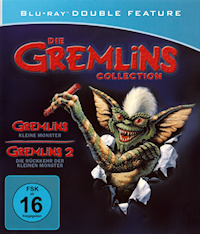
Gremlins
Cover

10.11.2025 #598

Title Gremlins
Studio Warner Bros. / Amblin Entertainment (1984)
Released by Warner Bros. (2012)
Disc Type BD-50 (26.7 GB) Bitrate ø 35 max. 40
Runtime 106:15 Minutes Chapter 28
Region Region-Free Case VIVA
Format HD 1080p24 AVC
Image 1.78:1 16:9 yes
Sound Dolby Digital TrueHD 5.1 Surround 1365 kbit/s English Dolby Digital 5.1 Surround English, German, French, Italian, Castellano, Spanish 1.0 Mono Portugese 2.0 Matrixsurround English, Commentary 1+2
Subtitles English, German, Italian, Castellano, Spanish, Dutch, Danish, Finnish, Norwegian, Swedish
Rating FSK 16
Extras • Over 10 Minutes of never-before-seen Footage
• Behind-the-Scenes Documentary
• Feature-Length Commentaries:
#1 With Director Joe Dante, Phoebe Cates, Zach Galligan, Dick Miller and Howie Mandel
#2 With Director Joe Dante, Producer Michael Finnell and Special Effects Artist Chris Walas
• Photo Gallery
• Theatrical Trailer

The Movie

Billy Peltzer (Zach Galligan) gets a strange Christmas gift: a small furry creature his father (Hoyt Axton) discovers in a mysterious shop in Chinatown. It comes along with three rules: protect it from bright light, do not feed it after midnight and do not let it get wet. This is, of course, an accident waiting to happen, and when Billy accidentally spills a glass of water on the little guy he calls Gizmo, he ends up with six new creatures, all of which are a little more dangerous and devious than the original. Together with his girlfriend Kate (Phoebe Cates) Billy tries to protect his little hometown from the dangerous beasts as good as he can…

Gremlin: imaginary mischievous creature supposed to cause mechanical or other failure.

It all goes back to the 1940s, when British RAF pilots and engineers in the second world war coined the term ‘Gremlins’ to explain strange faults in the machinery that appeared for no reason. Writer Roald Dahl, himself a former RAF pilot at the time, made the war folklore into his first book that was also supposed to be a collaboration with Walt Disney for an animated movie. The movie never came to be and the idea of Gremlins slowly faded from public consciousness, but never went away completely.

In the early 1980s, Hollywood was on top of its game. Each year amazing movies of all kinds stormed the boxoffice from all sorts of filmmakers. One of the hit-making machines was called Amblin Entertainment, founded by director Steven Spielberg and the producer couple Kathleen Kennedy and Frank Marshall. The first movies of the studio-independent production company were Michael Apted’s small comedy Continental Divide and their first two big hits Poltergeist and E.T. – The Extra-Terrestial. The latter made Amblin into a new household name in Hollywood that promised great things ahead. And then something unexpected arrived at the doorstep of Steven Spielberg – it was the Gremlins!

It was young filmmaker Chris Columbus’ idea of the Gremlins, a story about the old notion of mischievous critters ruining machinery and everyone’s good time. Possibly inspired by Road Dahl’s long-forgotten story but more based on the actual RAF folklore, Columbus had not really thought about making it actually into a movie. In the end Spielberg was so enarmoured with the concept that he bought the script and decided to bring it to Amblin. Busy with other projects he let Columbus loose on the story and started looking around for a director. Reportedly his first choice almost became Tim Burton – what a movie that would have been! – but then he picked Joe Dante, who was already working on Amblin’s Twilight Zone Movie and had some horror experience with the low-budget Piranha and the considerably higher-profile The Howling. Dante also brought his producer Mike Finnell into the project as his collaborator, the start of a long working relationship.

Steven Spielberg must have been attracted to Chris Columbus’ idea because it was somewhat similar to the two big projects of his friend George Lucas – Star Wars and Indiana Jones, both inspired by the b-movie serials of the 1930s and 1940s. Spielberg and Lucas had not tackled the horror movie genre yet and that was exactly what Columbus was aiming for. The busy director was only happy to delegate this project to others and let Joe Dante, Mike Finnell and Chris Columbus loose after he found a roof for it in the shape of Warner. It marked the first, but not the last time the studio worked together with Amblin Entertainment.

While Chris Columbus was working on the script, Joe Dante took a gamble on the casting with the blessing of Steven Spielberg and Warner: instead of an expensive high-profile cast, Gremlins would be equipped with relatively unknown actors. For the lead role of Billy, the 19-year-old Zach Galligan was chosen. With only one acting credit but exactly the right amount of innocence and slight mischievousness he makes Billy the perfect nice guy who is still a little bit between being just a kid and a responsible adult. After all, Zach Galligan turns out to be a competent monster fighter along with quite a few of his co-stars.

The female lead was also a somewhat bold choice. Unlike Zach Galligan, Phoebe Cates had already appeared in several movies in somewhat risqué roles and the producers were somewhat worried the wholesome character of Billy’s girlfriend Kate would not be a good choice for her. But when Cates and Galligan turned out to be a good match with great chemistry during the casting process, all worries were set aside. Kate turned out to be Phoebe Cate’s signature role for more serious acting because in Gremlins she was not just a simple scream queen especially in a crucial earnest scene that was almost excised from the movie because she acted so serious.

With two relatively unknown actors in the lead roles, Joe Dante called upon the creme de la creme of supporting actors – but it was not celebrity casting. Instead the director chose the many character actors appearing in classic movies from the past to give Gremlins even more nostalgia. Opening the movie are not Zach Galligan or Phoebe Cates, but Hoyt Axton as Billy’s father, singer-songwriter-actor who had appeared in a few movies since the 1960s but whose acting career really took off after Gremlins. Sadly he is somewhat underutilized in Gremlins, taken out of the main action by the plot that sends his character out of the way. The mysterious shop owner is portrayed by none other than Keye Luke, the Chinese-American actor who had been a star in the Charlie Chan and Green Hornet serials in the 1930s and 1940.

Another familiar face from her many appearances in 1970s and 80s television series and occasional movies was Frances Lee McCain as Billy’s spunky mother Lynn who starts out as the gentle housewife but turns into a serious adversary for the Gremlins, deftly dispatching several of them in her own house – nobody messes with Mama Peltzer. Some of the secondary characters were suffering more, like the Peltzers Neighbours, the Futtermans. Played by Hollywood veterans Jackie Joseph and Dick Miller they are mainly there for comedic relief but also for purely nostalgic reasons.

The movie does not only have the Gremlins as antagonists but also two human ones. Judge Reinhold plays Billy’s boss Gerald in his few scenes convincingly slimy, but Polly Holliday really steals the show as Mrs. Deagle, the cruel dog-hating bank owner. She is literally an homage to The Wizard of Oz’s Wicket Witch of the East and even wears the right shoe colours. Holliday, actually more known for her less scary sitcom roles in the 1970s and 1980s, has visible fun playing her character as evil and over the top as possible – she’s an absolute delight to watch even though she appears only in a few scenes.

The real stars of the movie are, of course, the Gremlins themselves. While Joe Dante didn’t made his movie completely into a special effects extravaganza and CGI was still in its infancy, the completely analog visual tricks used to bring the Gremlins to life are wonderfully charming and not at all realistic in a style reminiscing old horror movies. Created and designed by visual effects specialist Chris Walas, who had worked with Dante before on Piranha, the Gremlins were completely unique and a complex mix of puppetry, animatronics and even stop-motion animation.

Gizmo, the original Gremlin is a little cute puppet and remains so for the entire movie. He seems to be designed entirely for marketing purposes and Gizmo puppets were indeed sold a lot in the 1980s and 1990s. His offspring are reasonably cute at first too, but in a wink to Invasion of the Bodysnatchers they transform themselves into the actual bigger Gremlins – and this is where the design of Chris Walas really shines. A horror version of the cute fluffy Mogwais, they were slimy with lots of sharp claws and teeth and were meant to be really scary – but still had a little bit of cuteness in them.

While the movie features a whole army of them in the second half, most are generic with little variations except three standout characters like their leader Stripe and a few specific parodies. Overall, the Gremlins were not meant to be completely realistic and the handmade approach to the complex puppetry was exactly the right mix to make them as outrageous as possible. Their humour is mainly the absolute chaos and anarchy they produce plus their love of imitating and sometimes parodying human behaviour.

Although the Gremlins were mainly brought to life by Chris Walas and his team of experts, a crucial part of the creatures were their voices. Joe Dante called up voiceover legend Frank Welker, who even then already had a long career specializing in animal vocalizations. He was glad to provide the scary grumblings of the grown Gremlins but recommended comedian Howie Mandel for the sweeter tones of Gizmo. They were also joined by the talented voice and sound impressionists Michael Winslow and Peter Cullen amongst others and even Joe Dante himself contributes a little bit to the multitude of the excellent creature vocal effects.

Joe Dante also had the fortune to get Jerry Goldsmith for the film music. While the opening titles use an old pop christmas song to get that 1950s feeling going, Goldsmith’s brilliant involvement in the movie actually begins in the pre-credits sequence that features Gizmo’s theme. A simple but lovely little melody that repeats throughout the movie in several variations, the little cuddly guy’s audio signature sets an early tone that does not last too long. In a slow progression from fun and quirky to dark and scary with a lot of prominent melody-led themes. The score culminates in the bouncy, cheeky and anarchic Gremlin Rag that repeats from an earlier chaotic scene for the closing credits. One piece of music Goldsmith had nothing to do with was the loud pop song Gremlins Mega Madness specially recorded by Michael Sembello for the cafe scene which stands out like a sore thumb and does not really match anything in the score.

Set in the little fictional town of Kingston Falls and shot on the same town set as Back to the Future did only a short time later, Gremlins is also a Christmas movie and all about how the creatures ruin the holidays for everyone. Parts of the movie are actually so saccharine sweet that they turn the story into a parody of a Christmas tale and even the ultimate festive movie of all time, It’s A Wonderful Life is actually shown on an in-movie television amongst some other movie references.

The slow transformation from feel-good holiday story into full-blown anarchic chaos meant that studio executives were literally horrified by the first uneven rough cuts of the movie, even though Chris Columbus’ early drafts were even more gruesome than the final versions. Luckily, Joe Dante had the power of Steven Spielberg behind him and together they managed to save most of the the movie against the objections of the studio bigwigs who realized that they might actually have a hit on their hands.

It’s unknown if Gremlins was ever planned for a Christmas release, but it feels like it was planned to be shown on this particular holiday. The complicated shooting and the long post-production process however meant that the movie was released in Summer 1984 and had to battle two other big-budget adventure productions: Indiana Jones and the Temple of Doom and Ghostbusters. Together they formed a trilogy of unstoppable blockbuster movies that dominated the cinemas not only in the USA, but also worldwide.

Gremlins alone grossed around 150 million dollars in the US and was certainly a huge success, but did not come without criticism. While many reviewers loved the mix of comedy and horror and recognized the movie’s efforts of being an homage to old scary movies, some derided it as a quick violent money-making scheme. The violence became one of the main points of criticism, especially because the movie was billed as a PG comedy and many viewers who took their children to the cinema were surprised by the gruesomeness of the movie.

If Gremlins does have a fault, then it is that the movie does not really know if it wants to be a comedy or a horror movie. While the filmmakers have attempted to put the two elements together, they were not entirely successful. The comedy works and the horror does too, but at times they clash against each other. Fortunately it’s only a minor problem that would have been more serious if the overall movie wasn’t so well produced.

The complaints about the violence that also hit Indiana Jones and the Temple of Doom led to a heated discussion of the ratings system and the creation of the PG-13 rating in the USA. Even in Germany Gremlins originally had a FSK 12 rating but was later upped to 16 for the home video releases, a rating that stands until today. It was often heavily edited for television broadcast but all VHS, DVD and Blu-Ray releases always contained the uncut versions. This added to the movie’s notoriety but actually the violence and gruesomeness was mild compared to “real” horror movies.

Despite its exhausting and complicated production and the studio’s skepticism, Gremlins not only turned out to be a huge financial success but also the start of a long-lasting franchise. Once Warner had recognized what Gremlins was capable of, a huge ad and merchandizing campaign was geared up that did not only feature puppets of the creatures and other toys but also several tie-in marketing campaigns featuring posters, greeting cards and even the food industry joining in. The big star was of course the cuddly Gizmo, but even the ‘head Gremlin’ Stripe made some appearances.

Of course, Warner quickly demanded a sequel, but director Joe Dante initially refused because he and everyone else involved in the production were exhausted by the complicated shooting process. More than five years went by while Warner shopped the idea around to several other directors, but nobody took the bait until Joe Dante finally agreed to make the sequel himself. The result was a completely different film than the original and while it was not quite as successful, it is still considered a classic like its predecessor.

Four decades after its release, Gremlins remains one of the great films of the 1980s because it’s simply fun and creative and not just a dusty artefact of its time. Although it spawned only one sequel, it has influenced the horror-comedy genre so much that many more or less successful imitations have followed – and there is even talk of a new Gremlins movie!


The Disc

Gremlins and its sequel were originally released on DVD in one of the first batches of discs available at the start of the format as a feature-less affair. They were later followed up by special-edition re-releases in the early 2000s with restored transfers and very nice extras headed by entertaining audio commentaries, deleted scenes and more. When Warner chose Blu-Ray over HD-DVD in the brief HD format war, Gremlins and Gremlins 2 were in the first wave released on the new format – with the same extras as on the old DVDs but with new high-definition transfers that looked better and cleaner than before.

This German release of the Gremlins Blu-Ray has a copyright date of 2012 on the cover but seems to have been authored in 2009. It is sold separately and also in the 2-pack “Gremlins Collection”, although these are the same discs. Despite its age, this release can still hold up and is probably only slightly overshadowed by the 2019 UltraHD release.

Cover border=

Image

Warner’s second digital transfer of Gremlins that appeared on the 2002 special edition was already looking pretty good but for the 2009 Blu-Ray release a new high-definition transfer was created that improved it a lot.

The film source was in a much better shape than in the previous transfer. Except a few instances of dirt in the upper part of the opening credits, the transfer was cleaned very well with absolutely no scratches or other damages visible anywhere. The film grain was, however, largely left intact and is more or less visible depending on the lighting with dark scenes a bit more grainy. The analog film look is very nicely preserved on this Blu-Ray.

Very much improved are also the colours. Everything looks more vibrant with better contrast and more balanced brightness especially in the many dark scenes which show a lot more detail. The image is also very stable without any frame instability that was still a problem on the older transfer.

Sharpness and detail are okay but somewhat limited due to the film stock – it’s as good as a “flat” shot movie from the early- to mid-1980s should look. No visible sharpening or filtering was applied to artificially boost the image which makes it look very natural and not digital at all like some early Blu-Rays of that time.

Overall this is a very nice transfer that still looks great on larger screens. The newer 4K version reportedly is somewhat sharper, but also has some colour problems and seems to be slightly zoomed in, so the Blu-Ray might be the better version.

Sound

The Gremlins Blu-Ray has a multitude of soundtracks, probably because Warner only made one disc master worldwide. Almost all languages are represented in 5.1 mixes but only the original English comes in Dolby TrueHD.

Gremlins was originally mixed in two-channel matrix surround Dolby Stereo for the general release but Warner also made a few 70mm prints with 6-channel magnetic sound. Those were probably the basis for the 5.1 mixes that have appeared even on the first DVD release and have been further improved for the Blu-Ray.

The English 5.1 mix is presented in Dolby TrueHD with 1365 kbit/s and sounds largely identical to the previous mix of the DVD, albeit somewhat clearer and more punchy. The original discrete sound mix already has a very nice soundscape for a 1984 movie when multichannel sound began to be really well utilized and this new mix doesn’t change that. With voices mostly anchored into the center channel the front soundstage is still very lively with sound effects and of course the music that also spreads over to the rear channels. Discrete surround effects are rare but when the Gremlins really get going so does the soundtrack, providing an immersive audio experience that is remarkable for a movie of this age. Bass and treble are excellent and even the voices, especially Hoyt Axton’s sonorous intro voiceover, sound very natural.

There is also an English two-channel Dolby Surround mix with 192 kbit/s that sounds considerably flatter and while it decodes well in ProLogic, but has much less surround activity than the 5.1 track. It’s not a simple downmix of the 5.1 track but probably an archival version of the original Dolby Stereo track for the 35mm prints – a nice addition, but not necessarily good to listen to.

The German, French, Italian, Castellano and Spanish tracks are probably the same mixes as the English 5.1 track but with the dialogue stems switched out. They are only encoded in Dolby Digital though, but at least with the maximum 640 kbit/s. Only the Portugese soundtrack comes in 1.0 Mono with 192 kbit/s, probably because a discrete dialogue track could not be found.

There are also subtitles in all the languages of the audio tracks with additional subtitles in Dutch, Danish, Finnish, Norwegian and Swedish – but only for the main movie. The extras are not subtitled.

Bonus Materials

The worldwide Blu-Ray releases of Gremlins have almost exactly the same extras as the 2002 DVD release that was billed as a special edition. While no new documentary was produced, two fantastic commentary tracks, a short featurette, and ten minutes of previously unreleased footage truly deserve the “Special” label and do not disappoint. The only letdown are the menus of the Blu-Ray, because there is not even a proper main one – only a popup menu for the settings and a one-page listing of the special features.

The crown jewels of the extras are the two Audio Commentaries, labeled “Filmmaker’s Commentary” and “Cast & Crew Commentary” in the menus. Director Joe Dante, producer Michael Finnell and special effects artist Chris Wales provide the first track, focusing primarily on the technical aspects of the filming. Anyone expecting dry, technical jargon will be disappointed – Joe Dante and Michael Finnell had already demonstrated their highly entertaining storytelling skills on the commentary track for Innerspace and here they reminisce with great enjoyment about virtually every facet of the film’s production. From the first, much more violent script drafts to Steven Spielberg’s regular checks and technical problems with the Gremlins puppets, everything is included – especially regarding the latter, “puppet master” Chris Walas has quite a bit to say.

The second commentary track is again led by Joe Dante, but this time actors Phoebe Cates, Zach Galligan, Dick Miller, and Howie Mandel, the voice of Gizmo himself, join in. This track is even more lighthearted than the first, offering more anecdotes and other funny moments. Joe Dante, Zach Galligan, and Howie Mandel handle the lion’s share of this track, while Phoebe Cates seems rather bored, and Dick Miller simply can’t remember anything – the latter eliciting a few good-natured laughs. After about an hour, the participants start to tire, resulting in longer pauses, which are made up for by the end of the film. Despite Joe Dante’s presence on both audio commentaries, there is very little overlap, so both tracks are worth listening for the sheer entertainment value.

The Behind the Scenes Featurette (6:21) is exactly what it says it is – a vintage 1984 promotion of the movie, but not overly commercialized. In fact it’s a compilation of some old interviews and set footage from the filming on the Chinatown set, along with a slightly tongue-in-cheek explanation of what Gremlins actually are. The director and some of the actors speak briefly, as does a grinning young Steven Spielberg, who apparently wasn’t entirely comfortable in his role as executive producer. It’s certainly not a proper documentary, but despite its short runtime, it’s a nice historical document that doesn’t feel out of place here.

A total of eight additional scenes are included. Over ten minutes of footage were unearthed for this DVD, and Joe Dante, Michael Finnell, Zach Galligan, and Phoebe Cates even recorded an optional audio commentary for these scenes. The scenes are well preserved and presented in their original aspect ratio but sadly only in 4:3 letterbox 480p. Among them are two subplots featuring the bank manager and Judge Reinhold’s character, which could have easily been integrated back into the film. It’s not just leftover footage from the editing room; there’s some genuinely worthwhile material included.

Three Trailers were selected as promotional material : the theatrical and reissue trailers for Gremlins and also one for Gremlins 2, all now presented in anamorphic 480p but not re-transfered in HD like the deleted scenes.

While the biographies and production notes from the DVD have been left off the Blu-Ray there is now a Photo Gallery containing about 20 production photos in both colour and black and white, but only in a very small format

Comments off

Blu-Ray Review: The Great Train Robbery

Yes, it’s been more than a year since I posted something here and it was entirely due to the fact that the end of 2024 and the beginning of 2025 were absolutely terrible. Maybe a new start is in order? I can’t promise anything but there is at least enough material to review around and I still had this review lying around in an almost ready state: it’s Michael Crichton’s 1979 railway heist caper The Great Train Robbery!

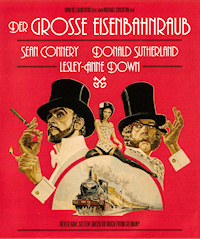
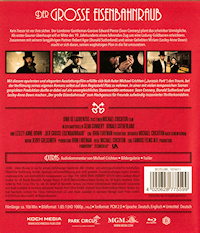
The Blu-Ray isn’t really new but I discovered it only recently and Koch Media’s German release is still the best one around worldwide. It also has a gorgeous based on the original poster art, something you don’t see much these days. Click through to the review, which is an expanded translation of a German version I wrote many years ago!

Continue to Review »

Kommentar schreiben

Blu-Ray Review: The Great Train Robbery

Water
Cover

12.10.2024
#597

Title The Great Train Robbery
Studio United Artists (1978)
Released by Koch Media (2018)
Disc Type BD-50 (38.9 GB) Bitrate ø 35
Runtime 110:52 Minutes Chapter 8
Region B (Germany) Case Keepcase
Format HD 1080p24 AVC
Image 1.85:1 16:9 yes
Sound DTS HD-Master 5.1 Surround 2048 kbit/s English 2.0 Surround English, German  Dolby Digital 2.0 Mono 224 kbit/s Commentary
Subtitles German
Rating FSK 12
Extras • Audio Commentary by Michael Crichton
• Image Gallery
• Trailer

The Movie

In the year 1855, England and France were at war with Russia in the Crimea. The English troops were paid in gold. Once a month, the gold was loaded into strongboxes at the London bank of Huddleston & Bradford and taken to the station by trusted, armed guards. The convoy followed no fixed route or schedule. At the station, the strongboxes were loaded into the luggage van of the Folkestone train for shipment to the coast and from there to France. The strongboxes were transported in two specially made safes, made of one-inch thick reinforced steel. Each safe weighed 550 pounds and was fitted with two locks, each with two keys. A total of four keys were required. For security reasons, each key was kept separately. Two keys were entrusted to the railway superintendent, who kept them in his office. A third was in the care of Mr. Edgar Trent, the president of Huddleston & Bradford. The fourth key was given to Mr. Henry Fowler, manager of Huddleston & Bradford. The accumulation of so much gold in one place naturally aroused the interest of criminal elements in England, but until 1855 there had been no robbery of a moving train… (The Great Train Robbery, Intro)


Opportunity makes a thief – this principle was often in effect in the history of the British railways. In the early days of the English railway network in the 19th century, there were hardly any robberies or raids, but when more and more companies began to transport valuables, money or even gold by train, the railways became interesting for criminal elements. A very unusual incident went down in history as the first major train robbery: in 1855, a clever duo of thieves, William Pierce and Edward Agar, managed to steal a large shipment of gold from a moving train on the route between London and Folkestone.

This Great Train Robbery remained relatively obscure for a long time and only became popular again in 1963, when a recent railway heist hit the headlines that turned out to be one of the largest robberies in European criminal history. The escape of ringleader Ronald Biggs occupied the media for decades and led to numerous literary and cinematic adaptations. A young author named Michael Crichton, who had enjoyed great success with his scientific thrillers since the mid-1960s, was not really interested in the 1963 train robbery, but in the lesser-known robbery of 1855, which gave him an opportunity to delve into the Victorian criminal world and not just concentrate on the robbery itself.

His novel The Great Train Robbery was published in 1975 and became an instant bestseller, particularly praised for its gripping portrayal of the 19th century underworld. Michael Crichton had heavily fictionalized the story of the eponymous train robbery, but nevertheless had used the true events and people as a basis, ensuring a very authentic atmosphere that almost bordered on a milieu study. The reduction to three main characters and the detailed description of the preparation and execution of the train robbery in the context of a factual report enabled a much more exciting and entertaining story than a completely faithful depiction.

At the beginning of the 1970s, Michael Crichton had not only established himself as a bestselling author, but also as a brilliant director with Westworld and Coma, after his science-fiction novel The Andromeda Strain had already been made into a film in 1971. It was directed by none other than Hollywood veteran Robert Wise, but Crichton himself wasn’t involved much in the production. The Great Train Robbery was to be the first film adaptation of his own work that the author was able to direct himself. This was only possible due to the success of his previous movies, which he had written directly for the screen. Sadly, his previous studio home, Metro-Goldwyn-Mayer, was not at all interested in a historical train robbery story, but with the help of producer John Foreman and the financial support of producing giant Dino de Laurentiis, he was able to bring The Great Train Robbery to United Artists instead.

Michael Crichton was also lucky enough to be able to attract the right actors for his project. For the main chatacter of Edward Pierce, the romanticized version of the real-life crook William Pierce, Crichton was able to get Sean Connery. The scottish actor had hung up his secret agent outfit in 1971 with Diamonds Are Forever and since then tried to move as far away as possible from his previous image – which wasn’t always easy. Connery had at least established himself as a brilliant character actor in big movies such as Murder on the Orient Express, The Man Who Would Be King and A Bridge Too Far.

His part in Michael Crichton’s film was therefore particularly important to him – instead of a Victorian James Bond, Sean Connery clearly enjoyed portraying a mischievous gentleman crook who also had his dangerous sides. Although the Scottish actor returned to the screens as James Bond one last time a few years later, The Great Train Robbery was the beginning of a major career change and one of his most successful and underrated performances in the 1970s.

Michael Crichton was also able to find a perfect actor for the second lead role in the film, the “screwsman” Robert Agar. Originally, the director only wanted to hire British actors, but the Canadian Donald Sutherland was just the ideal choice for the role of the awkward safecracker. Sutherland had in fact started his career in England in the 1960s and was already a busy character actor in high demand. He showed his enormous versatility in satires and comedies, dramas and thrillers and even war movies. The Victorian master thief Agar was a signature role for Donald Sutherland, which he mastered not only with costume and make-up, but also with his acting skills. With Sean Connery, Sutherland was also able to develop a successful dynamic that made the two characters even more lively.

While the characters in the book were almost exclusively a male club and the female characters only appeared in the background, Michael Crichton gave Pierce’s mysterious lover Miriam a much larger role in the screenplay adaptation and integrated her more into the plot. From the many young British actresses who would have been considered for the role, Lesley-Anne Down stood out. With her many years of film and television experience, she was chosen not only because of her looks. Just as in the book, the character’s profession is not mentioned in the film adaptation, but Lesley-Anne Down’s elegant demeanor and subtly humorous portrayal alone ensure that Miriam hardly seems to be just a street walker, but rather like a lady crook who is up to no good and can certainly hold her own against Pierce and Agar.

The other supporting characters were cast with more or less well-known British film and television actors and all had the same quality of being very impressive and memorable even in the smallest roles. The lecherous banker Henry Fowler was played with just the right amount of arrogance and sleaze by Malcom Terris, while theater veteran Alan Webb plays the stiff and almost unflappable railway boss Edgar Trent with wonderful eccentricity. The most astonishing casting in the film, however, is the role of the “Snakesmen” Clean Willy, for whom the filmmakers specifically hired the rarely seen dancer Wayne Sleep because he was able to attempt his breathtaking climbing stunts himself – a haunting performance that could not have been more realistic.

Although The Great Train Robbery was actually an American production by an American author and filmmaker, the film was not shot in Hollywood, but in England and Ireland. The latter was necessary because the original locations had proved to be too modern, but an untouched railway line with a suitable historic station and other ideal filming locations was found in Ireland. United Artists put together a first-class British film crew for Michael Crichton, which included the legendary cameraman Geoffrey Unsworth, production designers Maurice Carter and Art Davey and also costume designer Anthony Mendlesohn. However, the thoroughly British film crew was initially very reserved towards the young American filmmaker. Michael Crichton was able to dispel this scepticism by showing them his previous film Coma to gain their trust.

With a not too high but nevertheless generous budget of 6 million dollars, Michael Crichton was able to create an authentic atmosphere of Victorian England in the mid-19th century. In the British Pinewood Studios, detailed sets were built for the interior shots, but the exterior shots took place almost exclusively in Ireland and were elegantly complemented with a handful of old-fashioned, but effective matte paintings. Heuston Station in Dublin stood in for London Bridge Station, from where the train carrying the gold left for Folkestone, whose station was also represented by an Irish stop.

The filmmakers received a lot of support from the Railway Preservation Society of Ireland, using the historic railway line for the filming of the spectacular train scenes. A train with a real steam locomotive was used, which was actually built 25 years after the events of the story, but still looked very true to the original. The scenes in which Edward Pierce runs along the roof of the train were shot without a stunt double – much to the horror of the insurance company and of Sean Connery’s wife Michelle, who, according to legend, only learned of the actor’s stunts when she saw the film.

For the film’s musical accompaniment, Michael Crichton turned to the American composer Jerry Goldsmith, who had already scored the filmmaker’s previous film Coma and whose enormous versatility made him ideal for The Great Train Robbery. In 1979, Goldsmith had written three of his most famous scores – for Michael Crichton’s film, Ridley Scott’s Alien and the first Star Trek film – but The Great Train Robbery was one of his best and most fascinating works.

The catchy title theme immediately transports the viewer unmistakably to 19th century England and makes it clear in a light-hearted, mischievous way that the story is not meant to be a serious drama. Jerry Goldsmith’s sophisticated compositions were used relatively sparingly in the film, but are particularly effective for this very reason and work hand in hand with the detailed soundscape. Despite its great popularity, the film music was never released on record or CD – that only changed in 2004, when Jerry Goldsmith re-recorded and released the score faithfully to the original shortly before his death.

Although The Great Train Robbery was one of the most elegant and entertaining films of its time and while it boasted an all-star cast, the historical subject matter and the old-fashioned style almost proved to be the film’s downfall when it was released in 1979. At that time, the first big science fiction wave was raging on the cinema screens and Michael Crichton’s film had to compete with Star Wars, Star Trek, Alien and others, so its financial success was limited but it at least recouped twice the production costs. In England the film was given the title The First Great Train Robbery to distinguish it from the robbery of 1963 and the famous silent film of 1903, but most prints today only carry the shorter title.

While audiences initially showed only moderate interest, critics were enthusiastic across the board and attested to Michael Crichton’s great talent as an author and filmmaker. It was to be his last great success as a director, but as an author he remained one of the most creative and successful minds in both literature and cinema until his untimely death in 2008. Even today, The Great Train Robbery is still one of Michael Crichton’s most fascinating works both as a book and a film.

The Disc

Even though The Great Train Robbery was one of Michael Crichton’s masterpieces and was often a staple on TV in the 1980s and 1990s, it was always underrepresented on home video in the past. It took MGM until 1998 to release the movie on DVD in the USA and then only with a disappointing old non-anamorphic laserdisc transfer. At least the audio commentary Michael Crichton had recorded for the 1996 laserdisc release was included, but that was dropped again for the European DVD release in 2001 that was just a straight conversion of the Region 1 disc without the extras.

At some point a new high definition transfer seems to have been made in the late 2000s that was shown occasionally on American TV, but by then MGM had lost all interest in its classic film library and couldn’t be bothered to release it on home video anymore. In 2014, Kino Lorber finally stepped up in the USA and released The Great Train Robbery on Blu-Ray on its KL Studio Classics Label with a handsome new HD transfer, 5.1 sound and the classic Crichton commentary, preserving the movie for the high definition age.

Four years later Koch Media (now Plaion Pictures) brought essentially the same disc to the German home video market, although with a few improvements like a higher bitrate and uncompressed soundtracks. It’s also uncut for the first time with the controversial dog fighting scene intact. This is simply the best release of the movie so far worldwide. The same transfer can occasionally be seen on Amazon Prime Video or other streaming services, but in a lower quality than on this disc and of course without the few important extras.

Cover

Image

While MGMs old DVDs made absolutely no effort with the transfers, which were probably of early 1990s vintage and absolutely looked like it, Koch Media’s German release of The Great Train Robbery makes the movie shine for the first time in decades.

The origins of this 1080p 1.85:1 transfer are unknown but it was probably based on the master that was created for the 2014 American release by Koch Lorber. The film source seems to have been in very good shape – it already looked relatively clean in the 1990s transfers and appears here absolutely pristine without any instances of dust or scratches. There seems to have been a considerable effort of cleaning up the film elements, but fortunately the film grain was left intact and is always more or less visible.

Sharpness is good but not absolutely stellar due to the film source – but more than adequate for a “flat” 1.85:1 movie from the late 1970s that uses only part of the 35mm film strip. Luckily, there seems to have been no discernible artificial sharpness applied and thanks to the lack of a noise filter the image looks very organic and film-like – unlike some other HD transfers which sometimes are filtered to death. Stability is good but not completely rock solid – the image is sometimes a little bit in motion, but not to a point where it gets distracting.

The colours are wonderful and a far cry from the muddy brownish earlier transfers. Still looking vintage enough like the movie should be, greens are finally properly green and skies are nicely blue without cranking up the colour timing too much. Even the many darker scenes that have previously been just mushy and indiscernible now sport a wide palette of blue, brown and grey. The colour balance is just about right without looking too modern, even more like a 1950s Technicolor production.

Koch Media has also taken care that the authoring does not affect the image quality. Pressed onto a dual layer BD-50 disc, there is so much room that an almost constant 35 mbit/s bitrate was possible and the AVC compression is completely invisible.

Save for a complete restoration from the negatives, The Great Train Robbery has never looked better and is absolutely fit for big screens on this Blu-Ray. Given the relative obscurity of the movie nowadays, there will probably not be a new transfer for quite a while. Meanwhile this Blu-Ray is certainly good enough to enjoy the movie properly.

Sound

The Great Train Robbery had already been produced in Dolby Stereo in 1978, which was quite unusual for a movie of this vintage style. The old DVD releases already came with quite good Dolby Surround and 5.1 mixes which seem to have been reused for the Blu-Ray releases. For some reason the cover of the German Blu-Ray only specifies 2.0 LPCM tracks for both languages, but there is in fact a lossless English 5.1 Track included.

The English 5.1 soundtrack is a successful remix of the original four-channel Dolby Stereo mix – rumours that it was based on a 70mm 6-track mix are completely unfounded but at least it seems to have been made from the original separate stems. A large part of the surround sound is of course created by the score, which was mixed very broadly and relies heavily on the back channels. But the surround sound is not just limited to the music because the sound effects are also spread lightly around the front sounndstage and also use the surround channels quite a lot.

The dynamics and frequency range are impressively good and sound better than on the older releases. Especially the music now sounds much more full and even the dialogue seems to be improved a bit. It’s not quite a modern multichannel soundtrack, but sounds absolutely appropriate for a movie from 1978 and is especially a great showcase for Jerry Goldsmith’s music. In contrast to the international releases, the Koch Media Blu-Ray encodes all audio tracks in lossless LPCM.

When the German DVD was released in 2001, the German dub was only in Mono and hat a very scratchy thin sound.. This caused quite a stir because there were prints with a German Dolby Stereo mix and the movie was reportedly even shown with stereo sound on TV. Sadly, Koch Media was not able to locate this legendary Dolby Stereo mix and had to use a mono version instead again Fortunately it sounds much better on the Blu-Ray, although the sound quality is still not as good as the English original.

Subtitles are available in both English and German, but only for the main feature.

Bonus Materials

Koch Media has not billed The Great Train Robbery as a special edition, but still improved on the old German release by finally including the missing audio commentary and the customary trailer and a little image gallery. The menus are basic and only available in German, but look nice in the vintage style of the movie.

The Audio Commentary by Michael Crichton was recorded in the mid-1990s for the first laserdisc release and turned out to be an important document since the director and author sadly passed away in 2008. Here, he talks about the making of his movie in a quiet, reserved, but still highly entertaining way, unearthing a lot of anecdotes and details. Sometimes Crichton gets a little lost in thoughts and there is the occasional “dead air”, but hearing him lovingly talk about one of his favourite own movies is really worth watching the movie twice.

We also get three different Trailers for the US, UK and international release in the usual slightly worn quality, but newly transferred in HD.

The Image Gallery contains a nice collection of promotional material, but is not easy to navigate.


Comments off

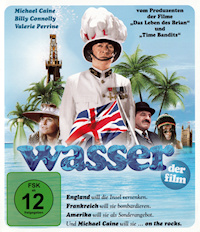
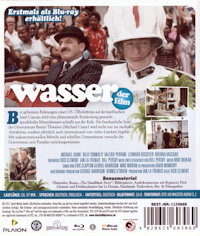
Blu-Ray Review: Water

To my great surprise, one of my favourite movies was released on Blu-Ray last year: 1985’s Water, one of the great Handmade Films comedies! It previously came out almost 20 years ago on DVD, which was a big surprise too. The Blu-Ray is “only” sourced from the same old HD master, but that’s good enough for a movie that was previously almost lost in the battle for the Handmade rights.

This review is actually the first of an “offline” disc on the new Cinefacts site – there will be more and I will try to post one roughly every week. Today it’s off to the Carribean with Michael Caine in one of the silliest parodies of the 1980s – click through to the review!

Continue to Review »

Comments off

Blu-Ray Review: Water

Water
Cover

12.10.2024
#597

Title Water
Studio Handmade Films (1985)
Released by Spirit Media (2023)
Disc Type BD-25 (22.9 GB) Bitrate ø 25
Runtime 97:25 Minutes Chapter 8
Region B (Germany) Case Keepcase
Format HD 1080p24 AVC
Image 1.78:1 16:9 yes
Sound DTS HD-Master 5.1 Surround 2048 kbit/s English, German 2.0 Surround English, German, Commentary
Subtitles German
Rating FSK 12
Extras • Audio Commentary with Dick Clement and Ian LaFrenais
• Die Handmade Story
• Filmtrailer
• Bildergalerie
• Handmade Trailershow

The Movie

The small Caribbean island of Cascara is still part of the British Commonwealth and has little to offer other than heat, wind and a population mainly descended from shipwreck survivors. Baxter Thwaites (Michael Caine) doesn’t have much to do as governor of the small island and tries to make life in diplomatic exile as pleasant as possible. But the peace is severely disturbed when an American oil company wants to shoot commercials on an old oil drilling platform. Suddenly the well starts bubbling again – not with oil, but with the finest mineral water. Cascara already sees itself as a rich island, but the Americans want to get their hands on the table water themselves. But then the British government decides to relocate the inhabitants to other islands for cost reasons. Baxter forgets his Britishness and takes unusual measures…

At the end of the 1970s, the British film industry was not exactly at the end of its rope, but it was at a disadvantage compared to its Hollywood competitors because many bigger film studios in the UK had collapsed. One of the few bright hopes was Handmade Films, a company originally founded by ex-Beatle George Harrison to finance the Monty Python film Life of Brian. Despite, or perhaps because of the controversy surrounding the biting religious satire, Life of Brian turned out to be a huge success and made Handmade Films a new star in the British film industry.

Handmade produced some of the best British films of the 1980s, many of which achieved enormous popularity and were soon considered classics. Terry Gilliam’s Time Bandits was one of their biggest productions, as were The Long Good Friday, Mona Lisa, A Private Function and Withnail & I. While these films were highly praised by critics, other Handmade productions hardly stood a chance if they were not sophisticated enough – the comedies in particular suffered from this and were often judged unfairly.

These included two movies from the British writing team Dick Clement and Ian LaFrenais, who had been creating original comedies for English television and cinema together since the 1960s. In 1983 they directed the adventure film parody Bullshot, based on the Bulldog Drummond serials from the 1930s and a popular parody theater play. Although it was not particularly financially successful, the people at Handmade Films, especially George Harrison, liked it so much that they asked the two authors for more ideas. So the authors decided to resurrect a script that they had been working on with their American friend Bill Persky.

It was the idea for Water, a parody of British colonialism, that Dick Clement and Ian LaFrenais brought to Handmade Films and quickly got the green light for – at least in principle. Before production could really begin, a suitable collection of actors, a South Sea island, an oil rig and a lot more had to be found. Amazingly, the filmmakers got everything together without any serious problems, which was probably due to the popularity of Handmade Films, but also because a lot of people liked their idea.

One of the enthusiastic ones was Michael Caine, whose career was not exactly at its peak in the early 1980s. He was, nevertheless, not afraid to get involved in an uncertain project like Water whose script he really loved. Just as Terry Gilliam had inspired Sean Connery for Time Bandits a few years earlier, Dick Clement and Ian LaFrenais had done the same with Michael Caine. Up to then, the British actor was not exactly known for his humorous side, but that was about to change.

With Michael Caine in the lead role, the production was as good as ready to go, because with a star like him involved. there was also hope for commercial success. The supporting roles were not cast with particularly big stars, but a whole group of excellent actors were found who were ideal for the many over-the-top characters. Scottish comedian Billy Connolly took on the role of Delgado, the singing rebel. Actually an accomplished musician himself, Connolly had no problem at all with the planned musical interludes. At his side was the relatively unknown English television actor Chris Tummings. The DJ from Radio Cascara, a smaller but importantl role, was played by the American television comedian Jimmie Walker in the best reggae-rasta manner.

Baxter’s crazy wife Dolores is a role that thrives on ridiculousness and the Italian-American actress Brenda Vaccaro excelled at playing the faded South American beauty perfectly over the top. In contrast to her, the role of Pamela Weintraub, the environmental activist who joins forces with Baxter defending the Island in the second half of the story, is almost underplayed by Valerie Perrine. Her character unfortunately got a bit lost in the story, but she makes the best out of the joint scenes with Michael Caine.

The other supporting roles were all brilliantly cast too. While Michael Caine played the perfect sloppy Englishman, Leonard Rossiter portrays the snobby British diplomat Sir Malcolm with wonderful exaggeration. Sadly it was his last film role because he passed away shortly after the film’s production. The wonderful Fulton McKay played the not-so-pious island priest, while Dennis Dugan as the blond Spenco henchman is wonderfully slimy.

And then there was Dick Shawn, a brilliant English comedian whose wonderful performance in Mel Brooks’ The Producers brought him a lot of fame. He only has a small, but memorable appearance as he highly exaggerated film star Deke Halliday in Water and was just perfect in his short appearance. Last but not least, the oil magnate Spender is played by none other than Fred Gwynne, who became world famous in the 1960s as Herman Munster, but was also a very talented and versatile actor and plays the Texan in a very scary but also quite humorous way.

Dick Clements and Ian LaFrenais’ script took a very simple story and developed it into something surprisingly complex. The relatively short film is filled with several subplots that are constantly intertwined. Water actually has enough material for several films: the fight for independence of a South Sea island that is neglected by British colonial policy and ultimately abandoned, the story of two singing amateur rebels, the oil company that encounters water and wants to compete with Perrier, the daughter of the oil multinational who rebels against her father and finally the broken marriage of the governor, whose wife would like nothing more than to flee the island.

All of this sounds pretty crazy and would probably fail completely on its own, but the two authors knew how to juggle the individual story elements with pinpoint accuracy. The humor never loses its touch and often dives deep into satire and parody – only when you’re English yourself you have the license to slander the British as mercilessly as in this film.

“I don’t care, I don’t give a damn, British justice is a farce and a sham,” yodels the singing rebel Delgado in the governor’s face, and that’s not all – English colonial policy is ridiculed just as disrespectfully. Water even doesn’t shy away from a portrayal of Margaret Thatcher, but the jokes never descend into the ridiculous. The humor lies less in the physical slapstick than in the brilliant texts, which were tailored perfectly to the actors.

Dick Clement, who also took over directing duties, and Ian La Frenais also assembled a top notch production team to make the movie look as good as possible. They were able to hire Douglas Slocombe, who had just completed shooting Indiana Jones and the Temple of Doom with Steven Spielberg. The veteran British cinematographer who began his career in the 1950s in the Ealing Studios shooting their classic comedies and took the same approach to Water – filming in colour, but in a quiet, conventional way with tight compositions and almost too nice views of the island.

Music was one of the main components of Water from the very beginning. Instead of a classical orchestral accompaniment, the musical accompaniment was to consist of newly composed pop, rock and reggae songs, and even a large concert scene with a star cast was planned. What would have been impossible for other filmmakers was no problem at all for Dick Clement and Ian LaFrenais – when one of the film’s producers is called George Harrison, there is no need to beg for the pop stars.

The title song and three more were composed and recorded by reggae legend Eddy Grant, and George Harrison also contributed a few pieces, which were created together with composer Mike Moran and supplemented by lyrics from the two screenwriters. For the big UN concert finale, a dream band was put together that could only exist on film – Eric Clapton, who also wrote the song, George Harrison, Ringo Starr, Jon Lord, Mike Moran, Ray Cooper and Chris Stainton as well as the background singers Jenny Bogle and Anastasia Rodriguez shared the stage with Billy Connolly and Chris Tummings in the mock UN headquarters.

The concept of Water sounds like a gimmick to spend a few weeks on holiday on a South Sea island and shoot a film at the same time – that may well have been what the filmmakers had in mind, but only part of the filming took place in the Caribbean. St. Lucia, the second southernmost island in the Lesser Antilles, was chosen for the fictional island of Cascara. Many of the exterior shots were shot in the coast town of Soufriere, where a lot of buildings are still recognizeable today.

St. Lucia did not prove to be barren enough for the remote side of Cascara, the island actually looked too nice. The scenes involving the oil rig – a real prop that was bought second-hand and shipped to the filming location – had to be shot in England on the cold Devon coast instead. A few interior shots were also filmed on well-equipped sets in the British Shepperton Studios.

Water is a successful mixture of over-the-top British humour, good music and a clever story that is simply great fun. Sadly, exactly that seems to have been the movie’s downfall, because many critics didn’t really get along with the British humor and, despite the star cast, Water didn’t receive much attention especially in the USA. In Germany, the film was released in cinemas in a version shortened by eight minutes, but later still became a long-running hit on video and television and an insider tip for fans of British humor. Over the years, the movie achieved an underground cult status together with many other Handmade Films productions, but was never easy to find until the mid-2000s.

The Disc

When the small German label Sunfilm released Water on DVD in 2005 together with a few other movies from Handmalde Films, it was the first release worldwide and a bit of a sensation. Sunfilm had worked hard on procuring a new 16:9 master and even commissioned an audio commentary by the filmmakers. When it emerged shortly before the release date that the English version was missing a short scene compared to the heavily edited German version, Sunfilm showed unusual initiative and quickly included the shorter 85-minute version, taken from an old video master, as a bonus on a second DVD.

What happened to Sunfilm in the next couple of years is unclear, but it seems that the label quietly ceased to exist and the German rights to a lot of Handmade films moved to other distributors. It took quite a while for this rare and curious movie to reappear – in 2023 the label Cinestrange announced an expensive Blu-Ray edition in three different Mediabook designs but later also a less expensive edition in a keepcase appeared.

The “plain” edition of Water is identical to the Mediabooks except the packaging and had all the extras from the previous DVD releases – except the second disc with the shorter German version that contains the one scene that is not in the international cut. This scene, that should have been located in the 24fps version at 41:19, now can truly be called “lost” because it was not even included as a bonus material.

Despite the terrible cover design of the non-mediabook release and the missing scene, this Blu-Ray of Water is a welcome upgrade of the DVD even though the transfer seems to be the same as almost two decades ago and could look a little sharper. But with a movie as rare as this, even an average Blu-Ray is a good Blu-Ray.

Cover

Image

The new German Water Blu-Ray seems to be based on the same high-definition transfer that Sunfilm was working so hard to get back in 2005 and while it does show its age a little bit it’s still a very good transfer of an 1980s movie.

The film source was cleaned so well that there are no dropouts apart from a few isolated small pieces of dust. Absolutely no scratches, reel change markers or other damage is visible. The film grain seems to have been left largely alone and is visible to a completely normal extent. It’s not at all distracting It gives the transfer a pleasant film-like texture and makes the image appear not too smooth and digital, but really lively.

Sharpness is quite good but shows some limitations due to the age of the transfer – but there’s still a good level of detail.. A sharpening filter doesn’t seem to have been used – if it was, then it did not leave any unpleasant side effects, because double edges or similar are nowhere to be seen. The colours are slightly muted and could pop a little more in some scenes, but overall look very natural and not like a movie from the 1980s at all.

The authoring is unobtrusive but since the movie was squeezed on a single-layer BD-25 the bitrate is not the highest, hovering around 20 mbit/s.

Under the complicated circumstances, Sunfilm had done everything to procure a decent transfer and it still looks good almost 20 years later – this is probably the best the movie will ever look.

Sound

While the 2005 DVD release contained the English soundtrack in its original 2.0 Dolby Surround mix and a newly created German track for the long version, the Blu-Ray adds 5.1 tracks for both languages that are a slight, but noticeable improvement.

The English 2.0 Surround mix seems to be identical to the one included on the DVD with the difference that it now runs at the correct 24fps, making the voices and especially the music finally sound exactly as intended. The music is the strong part of the soundtrack – while the early songs in the first part of the film almost seem like a mono mix, later the soundstage opens up and spreads out over the front channels and even the surround a little bit. Dialogue and foley are mostly constrained to the center channel, except for the music this is a very conventional mix but the voices sound clear and natural. Compared to the old tinny German soundtrack from the TV broadcasts, bass and treble are excellent and the music really kicks in well.

Where the second English 5.1 Surround track is coming from is unknown, but it’s a noticeable improvement of the original stereo-surround mix. It has the same strong sound but opens up the music mixed a little bit and makes more use of the surround channels. The dialogue is still anchored in the center, but the background sound now spreads out a little more. It seems like there was some subtle remixing and overall the 5.1 track is preferable to the original mix in every way without sounding like an artificial upmix.

The German 2.0 and 5.1 tracks are almost similar, almost none of the improvements of the English 5.1 track have made it into the German version. It’s still a good representation of the hybrid long version that was created by Sunfilm in 2005 out of the old German dub and the better sounding English version. Where possible, the music was replaced with the stereo version of the English soundtrack, but this was not possible everywhere because the music was sometimes edited differently in the German version. Only part of the soundtrack sounds as good as the English version, otherwise it still has the somewhat tinny sound of the German mono soundtrack.

All soundtracks are encoded in DTS HD-MA. Unfortunately there are no English subtitles, but German subtitles that were transcribed from the German version are included. A separate subtitle track is automatically activated when the German soundtrack is selected to translate the undubbed scenes.

Bonus Materials

The Water Blu-Ray carries over the extras from the DVD release, the unfortunately rather unexciting audio commentary, but also adds a few things. The nice menus from the DVD have been replaced with a disappointing amateurish new design.

The Audio Commentary with Dick Clement and Ian LaFrenais is a welcome surprise, but unfortunately not quite the sensation it could have been. Although the two filmmakers are initially very enthusiastic narrators, they run out of memories quickly and there are very, very long pauses. When Clement and LaFrenais come up with something really interesting and do not just announce the actors who will be appearing, they come across as very personable and entertaining, but unfortunately the phrase “I can’t remember” is heard far too often. The filmmakers leave the impression that they could have told a lot more with a little preparation.

The Handmade Story (24:37) is a short German-language documentary about the film studio originally created by Sunfilm for their releases in the mid-2000s. It was not included on the original Water DVD, but is available here in its original standard definition encoding.

The Handmade Trailer Show has blurry VHS-quality trailers of Mona Lisa, Five Corners, Nuns on the Run, Time Bandits, The Missionary and Shanghai Surprise – all in English language.

The Image Gallery (1:52) is a short video showing a collection of film posters and productions stills that was newly made for the Blu-Ray.

The Trailer (3:02) has a better image quality compared to the old DVD release but now only has a German soundtrack instead of the original English.

Comments off

Blu-Ray Review: The Ipcress File

The Ipcress File
Cover

1.8.2023 #596
Written by Guido Bibra

Title The Ipcress File
Studio Lowndes Productions / The Rank Film Organisation (1965)
Released by Koch Films (2020)
Disc Type BD-50 (35.5 & 26.7 GB) & DVD-5 (3.55 GB) Bitrate ø 35 max. 40
Runtime 107:36 Minutes Chapter 17
Region B (Germany) Case Mediabook
Format HD 1080p24 AVC (Disc 1&3) PAL 576i MPEG2 (Disc 2)
Image 2.35:1 16:9 yes
Sound DTS HD-Master 2.0 Mono 192 kbit/s English 2.0 Mono 192 kbit/s
English, German, Commentary
Subtitles English, German
Rating BBFC PG
Extras • Commentary with Director Sidney Furie and Film Editor Peter Hunt
• New Exclusive Interview with Sir Michael Caine
• New Exklusive Interview with Production Designer Sir Ken Adam
• “The Ipcress File – Michael Caine goes Stella”
Exclusive new comedy sketch starring Phil Cornwell
• 1969 Documentary “Candid Cane”
• Original US Radio Commercials
• Stills Gallery
• Documentary “My Generation” by Michael Caine
• 17 Page Booklet

The Movie

Harry Palmer is just one small agent among many and not particularly enthusiastic about his job. When he is put on a boring but seemingly harmless routine assignment to investigate the disappearances of British scientists who later turn up brainwashed, he doesn’t have much hope of finding out a lot. But then he comes across an audio tape snippet with the mysterious inscription Ipcress – and soon events come to a head and Palmer no longer knows whom he can really trust…

When the first James Bond film was released in 1962, Len Deighton had published his first book The Ipcress File in the wake of the burgeoning spy craze, which quickly became a successful bestseller. The author, who originally worked in advertising as an illustrator and for some time had his own cooking comic strip in The Observer, was hailed by his critics as a new Ian Fleming whose tales were more realistic. Even Bond movie producers Albert R. Broccoli and Harry Saltzman took notice of the young writer and hired him as the first screenwriter for their new Fleming adaptation From Russia with Love, but they replaced him soon because he was not working fast enough and they didn’t like his style.

But Harry Saltzman had not forgotten Len Deighton’s unusual spy thriller with the nameless anti-hero and soon acquired the film rights to The Ipcress File and its sequels. A film adaptation was still some time away, as Saltzman, together with his partner Albert Broccoli, wanted to concentrate on the James Bond series first. After the great success of the first three movies, Saltzman saw an opportunity to bring an alternative to Ian Fleming’s secret agent into the cinemas- someone who was almost the opposite and represented a kind of spy that had never been seen before on the big or small screen.

Comparing Len Deighton’s agent with James Bond is obvious, but the two characters could not be more different: Bond is a secret agent with heart and soul and would let himself be torn to pieces for Queen and Country. Deighton’s nameless spy, who only acquired the name Harry Palmer for the movies, is just a lowly worker who is considered replaceable and superfluous by his superiors, never does his assignments completely voluntarily and certainly does not enjoy his work. He has no choice because he is being held responsible for some black market shenanigans during the war and his superior is actually not the secret service, but the war ministry.

Harry Palmer was not supposed to be a glorious spy, but just a disillusioned soldier who has to work off his sentence as an involuntary agent to escape worse. Nevertheless, he is no crook and has a sense of justice, but in the end all he cares about is how much he has in his bank account at the beginning of the month. After all, even a secret agent has to live somehow, especially if he has to beg his superiors for every little expense. Despite his small flat and modest private life, Palmer does have certain personal standards – his penchant for cooking, classical music and beautiful women are somewhat reminiscent of Johannes Mario Simmel’s Thomas Lieven, who is also one of the few involuntary agents in spy literature.

Originally, Harry Saltzman wanted to cast Christopher Plummer in the lead role, but the already established actor was not comfortable with a five film contract for an uncertain project and preferred to star with Julie Andrews in the musical The Sound of Music. Richard Harris also turned it down, so Saltzman had to look for other young actors and came across Michael Caine, who had been working in the theatre and in supporting roles in movies since the 1950s and was still waiting for his big break. After seeing him in his first big movie role in Zulu, Harry Saltzman signed Michael Caine and promised to make him a second James Bond – but in a completely different way.

Michael Caine proved to be the ideal choice for the laconic agent, whom he played in a very restrained, natural and somewhat satirical way and so came surprisingly close to Len Deighton’s book template. In addition, he was able to get his wish fulfilled to wear his glasses in the film so that he could simply take them off for other movies, not being trapped by his secret agent role. Short-sightedness and an everyman appearance were not the only trademarks of Harry Palmer, but also the dry and bitter cynicism of the novel, which Michael Caine knew how to bring perfectly to the screen despite his relatively restrained performance.

Michael Caine was supported by an excellent cast of actors who, just like him, were not big stars at the time. The biggest name in the cast list was British actor Nigel Green, playing Palmer’s new superior Major Dalby with a quintessential British military stiffness, making him not exactly one of the most likeable characters in the film. This was not the first time Nigel Green had appeared in front of the camera with Michael Caine, as the two actors had already appeared together a year earlier in Cy Coleman’s African war drama Zulu. The busy actor was able to demonstrate his skills brilliantly in The Ipcress File, making a memorable unsympathetic character out of Major Dalby.

For the role of Palmer’s old boss Colonel Ross, Harry Saltzman was able to recruit New Zealand actor Guy Doleman, whom he had previously hired for a small supporting role in the fourth Bond film Thunderball. His appearance in The Ipcress File is much larger, giving Doleman the opportunity to demonstrate a typically British bureaucrat, much like his co-star Nigel Green. Colonel Ross is by no means as unsympathetic as Major Dalby and, with his dry manner and his disparaging way of handling his subordinate Harry Palmer, is somewhat reminiscent of James Bond’s superior M.

Len Deighton had already included an unusual female supporting character in the novel, who also plays a small but important role in the film adaptation: Harry Palmer’s new colleague Jean, who is portrayed in the film very cool and mysterious by the relatively unknown actress Sue Lloyd. She has little to do with the glamorous girls of the James Bond films and even seems more like a strict Miss Moneypenny than a provocative spy playmate, but on the other hand she does not correspond at all to the usual stereotype and can also convince with intelligence and not only with her looks.

Harry Saltzman chose the young Canadian Sidney J. Furie as director, but soon wished he had found someone else: the producer was appalled by his seemingly chaotic working style. A fight quickly broke out between the tempestuous Saltzman and Furie, who at one time fled the production to escape from the producer’s tantrums and was only brought back by the persuasion of the crew and actors. Furie carried on despite the troubles and pushed through his unconventional methods, even if Harry Saltzman didn’t like it.

Together with veteran cameraman Otto Heller, Sidney J. Furie created an unusual visual style. The camera often showed the action from adventurous angles and the view of the wide Techniscope image is often obscured by objects, creating the unsettling impression of surreptitious observation. The unusual image composition seems strange at first glance, but works wonderfully as a narrative trick and gives the film a look all of its own, which was later often copied by many, but never used to such great effect as in The Ipcress File.

The screenplay adaptation by Bill Canavay and James Doran, two relatively unknown authors, naturally had to remove a lot from the very detailed and extensive novel. Only a few basic ideas were used, but the characters and the dark and pessimistic mood remained largely intact. A voiceover as an implementation of the first-person narrator was not employed because the vast amounts of text would have been too much for a film script and a running commentary would have destroyed the atmosphere of the film. This was compensated with an above-average amount of dialogue.

In contrast to the book, the plot takes place entirely in London, which was obviously a decision made mostly for economic reasons. Exciting parts of the book involving a nuclear weapons test were entirely removed, but this was was done in close cooperation with Len Deighton who contributed a few new ideas of his own. As a result, the implementation of the basic concept succeeded surprisingly well and was able to remain very faithful to the original story despite the massive deviations.

The plot remained complex and had little in common with other films of the genre, which were mostly constructed around action scenes. There are no big spectacles in The Ipcress File save for the explanation of the titular MacGuffin resulting in an uncomfortable torture scene, but nevertheless the plot has a surprising amount of story to offer. Lots of dialogue and very little classic action make The Ipcress File a downright intellectual film. Viewers who switch off their brain for even five minutes are liable to immediately lose the plot given the heavy density of the story. The Ipcress File is like a jigsaw puzzle – at the beginning the individual pieces hardly make any sense, only in the course of the movie their meaning slowly become apparent.

Instead of using lavish studio sets, The Ipcress File was mainly shot on original locations in London. It was, however, not the colourful swinging London of the sixties, but a grey, rainy big city that does not look particularly inviting. but is all the more authentic. The film’s setting is also a valuable contemporary document, showing a side of the British capital from the mid-1960s that is not often seen in movies of that time. Sidney J. Furie and cinematographer Otto Heller had achieved this by showing the city not from the exciting perspective of a tourist, but from the everyday view.

Ken Adam, who had previously made a name for himself with the gigantic sets of the Bond movies, was responsible for the production design and was Harry Saltzman’s first choice for The Ipcress File. His outlandish constructions were less in demand this time, as the task was to construct entirely ordinary looking sets. Although some scenes were staged at Pinewood Studios, the majority of the interior shots were filmed in a London apartment building converted into a studio, which doubled as a canteen, office and many other production departments. Ken Adam ensured that the sets were given a completely realistic look, which turned out to be a masterpiece precisely because of its unobtrusiveness.

In addition to editor Peter Hunt, producer Harry Saltzman had also borrowed another indispensable collaborator from the staff of the Bond films: composer John Barry, who had given the films his own very distinctive sound. For The Ipcress File, he remained largely true to his style, but showed his versatility by writing a very unusual theme music. Instead of a cracking title song, the opening credits are accompanied by a quiet, melancholic melody that excellently expresses the dark and mysterious mood of the film.

John Barry achieved the very special sound of his film score this time not only with his characteristic brass sections or an electrifying guitar solo, but mainly with the cimbalom, a dulcimer-like string instrument that is used more effectively in The Ipcress File than in any other film score. The title melody played on it is heard in many different arrangements, not all of which use the rare instrument as a solo voice, but which consistently employ an equally unusual rhythmic accompaniment of vibraphone, flute and only very sparingly used brass. With this unusual instrumentation, John Barry has created an impressively innovative film score.

The Ipcress File could have been a serious rival to the James Bond films, but the intelligent style of the movie with its extensive dialogue and complex plot was not really suitable for mass audiences. As a result, the big success failed to happen, but nevertheless The Ipcress File was able to win over quite a respectable regular audience and the critics were also consistently enthusiastic about the unusually sophisticated entertainment. In the End, Harry Palmer’s first adventure had two successors with Funeral in Berlin and The Billion Dollar Brain, which were not really big successes either, but count among the best spy movies of the sixties and today enjoy an excellent reputation as real classics.

For Michael Caine, the film marked the start of a long acting career that continues to this day. Hardly anyone, however, can remember that today’s character actor once started out as the small-time secret agent Harry Palmer. The popularity of The Ipcress File, known in Germany by the relatively accurately translated title Ipcress – Streng Geheim, is limited and very much overshadowed by the competition, mainly of course the Bond franchise. But on the more realistic side of the genre, only John LeCarré and of course Len Deighton remain, whose The Ipcress File is one of the very best spy film adaptations.


The Disc

The Ipcress File had already been released on DVD by Anchor Bay in the USA in 1999, but unfortunately this disc has been out-of-print for a long time – this was a great pity, as it contained an excellent audio commentary with the late director Sidney J. Furie and editor Peter Hunt. In 2003 Koch Media released the film in Germany in very good quality, but without the commentary track. Fortunately the track surfaced again in a 2005 special-edition DVD release from Network in the UK that also contained quite a few new extras.

In 2014, the Network DVD release was upgraded with a new high-definition restoration for a Blu-Ray that had all the extras of the earlier version but a much improved transfer. It took a while for Koch to catch up, but in 2020 they finally delivered and released an expensive, but elegant special edition that not only contained all the British extras but also a third disc with Michael Caine’s My Generation documentary and a 17-page booklet inside a stylish Mediabook hardcover. Koch’s version of The Ipcress File is now simply the best one out there preserving the movie perfectly for the future.

Cover

Image

The new high-definition master on Koch Film’s Blu-Ray was created for the 2014 UK release by ITV and Network and is a proper 2k restoration of The Ipcress File that improves upon the old DVDs in basically every aspect.

The Ipcress File was shot in Techniscope, which uses just half the frame size as the usual Panavision anamorphic scope format and therefore has higher graininess and a somewhat reduced quality. Techniscope, however, was popular with many directors in the 1960s not only for cost reasons, but also because normal spherical lenses could be used, allowing image compositions that would have been difficult or impossible to create with anamorphic lenses.

The film master used for the new transfer has been thoroughly cleaned without a single instance of dirt, scratches or other debris visible. Compared to the old DVDs, the new transfer surprisingly shows a significant larger part of the film frame, with more visible on all sides. The film grain has thankfully been left completely intact and is constantly visible, but is unintrusive and preserves the film-like texture perfectly like it should be with a Techniscope movie. Sharpness is surprisingly good, but has its limits due to the source format – but the image never leaves the impression of being blurry or unsharp even though no additional sharpening seems to have been applied. The image is also very stable and the slight horizontal jitter previously noticeable has been completely eliminated.

The unusual colour timing from the earlier transfers has also been improved a lot and doesn’t look like a faded copy of the film anymore. The colours are still muted, but skin tones now look much more realistic and the many bright highlights visible in the earlier versions have been reigned in as well. Now The Ipcress File looks more like mid-1960s Technicolor again without sacrificing the moody atmosphere of the movie, which is still wonderfully intact.

Overall, this is a perfect representation and preservation of a movie that is approaching its 60th birthday soon.

Sound

The soundtracks of the Blu-Ray release seem to have been newly restored by ITV and Network for the 2014 release and like the new transfer, improve on the old versions a lot. In addition to a restored mono track an English 5.1 upmix is now also available. All soundtracks have been encoded in DTS HD Master Audio.

Frequency response and dynamics of the restored mono are still somewhat limited due to age, but bass and treble have been improved a lot. Noise or crackle are absent, the sound is very clean and does not exhibit any typical optical track problems – this sounds like a magnetic source, which was very carefully transfered without being filtered to death. John Barry’s music sounds almost crystal clear and the slight distorions of the earlier incarnations are almost gone too. The dialogue is very well intelligible and only rarely sounds a little thin, but overall much better than some other films of this age. Still noticeable is the sometimes slightly poor lip sync, but this is not a mastering fault and was only caused by less than perfect dubbing during film production.

The English 5.1 track was newly created during the 2014 restoration, but is very close to the mono track. The music was sadly not remixed from stereo sources and has only been opened up slightly with some slight spread across the frontal sound stage. Bass and treble are basically the same as on the Mono track and the voices are also anchored in the middle channel. Only a few sound effects have been spread very slightly over all channels, but not in a distracting way. This is a very careful remix that almost seems unnecessary but is still welcome.

The German Mono track is also in good shape and seems to be based on the English Mono track mixed with the German dialogue. The voices sound somewhat more artificial and tinny than in the original, but are still fine and slightly better than on the previous German DVD release – Koch seems to have taken good care of the track. There are a few instances where the English soundtrack comes back because there have been some slight cuts in the German version.

Extras

Koch’s Blu-Ray release of The Ipcres File is not missing out and contains all the extras from the Network UK release and also adds a third disc with the 2017 Michael Caine documentary My Generation. The elegantly designed mediabook also includes a 17-page booklet with a German essay by Thorsten Hanisch.

Disc 1 (Blu-Ray)

The first disc has the Audio Commentary with director Sidney J. Furie and editor Peter Hunt, recorded in 1999 for the American Anchor Bay release. Peter Hunt passed away in 2002, so this commentary track is an important document and not a dull affair at all. Furie and Hunt are an extremely talkative duo and, while they can’t always remember everything, they take their own forgetfulness in good humour and still reveal quite a lot of anecdotes. The many problems of the film’s production also come up, and Sidney J. Furie talks openly about the trouble he had with Harry Saltzman. Despite a few small breaks, this commentary track is extremely lively entertaining.

The first disc also contains the Trailer (1:05) in HD and the original 2.35:1 letterboxed format, but it looks like it was upscaled from the DVD.

Trailers from Hell (1:20) is a short but concise introduction to the movie from the eponymous website by Howard Rodman, new to this Blu-Ray

The Radio Spots are the Original US Radio Commercials from the british release- Four radio commercials that have nostalgia value but are nothing really special.

The Textless Material (4:27) has been, like the main movie, re-scanned in high definition and consists of the film’s opening and closing credits – but without the text overlays and without sound. Intended strictly for the archive and international releases, it is nevertheless amazing that this has been included on this release too.

The Stills Gallery was also ported from the old DVD release, but remastered in HD and a slightly better format. With 123 large-format production photos and posters, this is surprisingly well stocked.

Disc 2 (DVD) has all the remaining extras from the 2005 Network release in Standard Definition.

Candid Cane (44:20) is an old London Weekend Television programme from 1969 that covers in detail the still very fresh career of Michael Caine, who is featured in an extensive interview.Although there is of course a high nostalgia factor involved, this particular type of documentary is an ideal complement to the other extras on the DVD and not just an embarrassing supplement dusted off from some oldarchive.

The Interview with Michael Caine (21:08) was newly produced for the 2005 Network release and is actually not a simple interview at all, but a small documentary in which Michael Caine tells many interesting stories about the making of the film and his role. Professionally edited with some short film clips and photos, this interview documentary has very high information content despite its short running time.

The Interview with Production Designer Ken Adam (10:30) is structured very similarly to the first interview and also gives more the impression of a mini-documentary. The featurette is actually only so short because Ken Adam (armed with his eternal cigar) quickly gets to the point and describes his work on The Ipcress File in an impressively concise manner.

The Ipcress File – Michael Caine goes Stella (4.57) is a short sketch with Phil Cornwell as a remarkably good Michael Caine impersonator, giving a brief but crisp introduction to The Ipcress File and his further career. Phil Cornwell could indeed be mistaken for a young Michael Caine, but after all, he has been perfecting this and many other roles in the English sitcom Stella Street for a long time.


Disc 3
(Blu-Ray)

My Generation
(85:25) is the only extra occupying the third disc exclusive to the German release, a Blu-Ray containing Michael Caine’s own 2017 documentary about the 1960s. Actually written by comedy writers Dick Clement and Ian LaFrenais and directed by David Batty, it contains an abundance of archival footage and lots of interviews with many sixties icons from art, music and movies led by Michael Caine himself. Although only vaguely related to The Ipcress File, it’s a very nice extra that is not available separately.

Cover

Comments off