 Gremlins Gremlins |
||||
10.11.2025 #598 |
Title | Gremlins | ||
| Studio | Warner Bros. / Amblin Entertainment (1984) | |||
| Released by | Warner Bros. (2012) | |||
| Disc Type | BD-50 (26.7 GB) | Bitrate | ø 35 max. 40 | |
| Runtime | 106:15 Minutes | Chapter | 28 | |
| Region | Region-Free | Case | VIVA | |
| Format | HD 1080p24 AVC | |||
| Image | 1.78:1 | 16:9 |  |
|
| Sound |  TrueHD TrueHD  English English  English, German, French, Italian, Castellano, Spanish Portugese English, German, French, Italian, Castellano, Spanish Portugese  English, Commentary 1+2 English, Commentary 1+2 |
|||
| Subtitles | English, German, Italian, Castellano, Spanish, Dutch, Danish, Finnish, Norwegian, Swedish | |||
| Rating | FSK 16 | |||
| Extras | • Over 10 Minutes of never-before-seen Footage • Behind-the-Scenes Documentary • Feature-Length Commentaries: #1 With Director Joe Dante, Phoebe Cates, Zach Galligan, Dick Miller and Howie Mandel #2 With Director Joe Dante, Producer Michael Finnell and Special Effects Artist Chris Walas • Photo Gallery • Theatrical Trailer |
|||
|
Billy Peltzer (Zach Galligan) gets a strange Christmas gift: a small furry creature his father (Hoyt Axton) discovers in a mysterious shop in Chinatown. It comes along with three rules: protect it from bright light, do not feed it after midnight and do not let it get wet. This is, of course, an accident waiting to happen, and when Billy accidentally spills a glass of water on the little guy he calls Gizmo, he ends up with six new creatures, all of which are a little more dangerous and devious than the original. Together with his girlfriend Kate (Phoebe Cates) Billy tries to protect his little hometown from the dangerous beasts as good as he can… Gremlin: imaginary mischievous creature supposed to cause mechanical or other failure. It all goes back to the 1940s, when British RAF pilots and engineers in the second world war coined the term ‘Gremlins’ to explain strange faults in the machinery that appeared for no reason. Writer Roald Dahl, himself a former RAF pilot at the time, made the war folklore into his first book that was also supposed to be a collaboration with Walt Disney for an animated movie. The movie never came to be and the idea of Gremlins slowly faded from public consciousness, but never went away completely. In the early 1980s, Hollywood was on top of its game. Each year amazing movies of all kinds stormed the boxoffice from all sorts of filmmakers. One of the hit-making machines was called Amblin Entertainment, founded by director Steven Spielberg and the producer couple Kathleen Kennedy and Frank Marshall. The first movies of the studio-independent production company were Michael Apted’s small comedy Continental Divide and their first two big hits Poltergeist and E.T. – The Extra-Terrestial. The latter made Amblin into a new household name in Hollywood that promised great things ahead. And then something unexpected arrived at the doorstep of Steven Spielberg – it was the Gremlins! It was young filmmaker Chris Columbus’ idea of the Gremlins, a story about the old notion of mischievous critters ruining machinery and everyone’s good time. Possibly inspired by Road Dahl’s long-forgotten story but more based on the actual RAF folklore, Columbus had not really thought about making it actually into a movie. In the end Spielberg was so enarmoured with the concept that he bought the script and decided to bring it to Amblin. Busy with other projects he let Columbus loose on the story and started looking around for a director. Reportedly his first choice almost became Tim Burton – what a movie that would have been! – but then he picked Joe Dante, who was already working on Amblin’s Twilight Zone Movie and had some horror experience with the low-budget Piranha and the considerably higher-profile The Howling. Dante also brought his producer Mike Finnell into the project as his collaborator, the start of a long working relationship. Steven Spielberg must have been attracted to Chris Columbus’ idea because it was somewhat similar to the two big projects of his friend George Lucas – Star Wars and Indiana Jones, both inspired by the b-movie serials of the 1930s and 1940s. Spielberg and Lucas had not tackled the horror movie genre yet and that was exactly what Columbus was aiming for. The busy director was only happy to delegate this project to others and let Joe Dante, Mike Finnell and Chris Columbus loose after he found a roof for it in the shape of Warner. It marked the first, but not the last time the studio worked together with Amblin Entertainment. While Chris Columbus was working on the script, Joe Dante took a gamble on the casting with the blessing of Steven Spielberg and Warner: instead of an expensive high-profile cast, Gremlins would be equipped with relatively unknown actors. For the lead role of Billy, the 19-year-old Zach Galligan was chosen. With only one acting credit but exactly the right amount of innocence and slight mischievousness he makes Billy the perfect nice guy who is still a little bit between being just a kid and a responsible adult. After all, Zach Galligan turns out to be a competent monster fighter along with quite a few of his co-stars. The female lead was also a somewhat bold choice. Unlike Zach Galligan, Phoebe Cates had already appeared in several movies in somewhat risqué roles and the producers were somewhat worried the wholesome character of Billy’s girlfriend Kate would not be a good choice for her. But when Cates and Galligan turned out to be a good match with great chemistry during the casting process, all worries were set aside. Kate turned out to be Phoebe Cate’s signature role for more serious acting because in Gremlins she was not just a simple scream queen especially in a crucial earnest scene that was almost excised from the movie because she acted so serious. With two relatively unknown actors in the lead roles, Joe Dante called upon the creme de la creme of supporting actors – but it was not celebrity casting. Instead the director chose the many character actors appearing in classic movies from the past to give Gremlins even more nostalgia. Opening the movie are not Zach Galligan or Phoebe Cates, but Hoyt Axton as Billy’s father, singer-songwriter-actor who had appeared in a few movies since the 1960s but whose acting career really took off after Gremlins. Sadly he is somewhat underutilized in Gremlins, taken out of the main action by the plot that sends his character out of the way. The mysterious shop owner is portrayed by none other than Keye Luke, the Chinese-American actor who had been a star in the Charlie Chan and Green Hornet serials in the 1930s and 1940. Another familiar face from her many appearances in 1970s and 80s television series and occasional movies was Frances Lee McCain as Billy’s spunky mother Lynn who starts out as the gentle housewife but turns into a serious adversary for the Gremlins, deftly dispatching several of them in her own house – nobody messes with Mama Peltzer. Some of the secondary characters were suffering more, like the Peltzers Neighbours, the Futtermans. Played by Hollywood veterans Jackie Joseph and Dick Miller they are mainly there for comedic relief but also for purely nostalgic reasons. The movie does not only have the Gremlins as antagonists but also two human ones. Judge Reinhold plays Billy’s boss Gerald in his few scenes convincingly slimy, but Polly Holliday really steals the show as Mrs. Deagle, the cruel dog-hating bank owner. She is literally an homage to The Wizard of Oz’s Wicket Witch of the East and even wears the right shoe colours. Holliday, actually more known for her less scary sitcom roles in the 1970s and 1980s, has visible fun playing her character as evil and over the top as possible – she’s an absolute delight to watch even though she appears only in a few scenes. The real stars of the movie are, of course, the Gremlins themselves. While Joe Dante didn’t made his movie completely into a special effects extravaganza and CGI was still in its infancy, the completely analog visual tricks used to bring the Gremlins to life are wonderfully charming and not at all realistic in a style reminiscing old horror movies. Created and designed by visual effects specialist Chris Walas, who had worked with Dante before on Piranha, the Gremlins were completely unique and a complex mix of puppetry, animatronics and even stop-motion animation. Gizmo, the original Gremlin is a little cute puppet and remains so for the entire movie. He seems to be designed entirely for marketing purposes and Gizmo puppets were indeed sold a lot in the 1980s and 1990s. His offspring are reasonably cute at first too, but in a wink to Invasion of the Bodysnatchers they transform themselves into the actual bigger Gremlins – and this is where the design of Chris Walas really shines. A horror version of the cute fluffy Mogwais, they were slimy with lots of sharp claws and teeth and were meant to be really scary – but still had a little bit of cuteness in them. While the movie features a whole army of them in the second half, most are generic with little variations except three standout characters like their leader Stripe and a few specific parodies. Overall, the Gremlins were not meant to be completely realistic and the handmade approach to the complex puppetry was exactly the right mix to make them as outrageous as possible. Their humour is mainly the absolute chaos and anarchy they produce plus their love of imitating and sometimes parodying human behaviour. Although the Gremlins were mainly brought to life by Chris Walas and his team of experts, a crucial part of the creatures were their voices. Joe Dante called up voiceover legend Frank Welker, who even then already had a long career specializing in animal vocalizations. He was glad to provide the scary grumblings of the grown Gremlins but recommended comedian Howie Mandel for the sweeter tones of Gizmo. They were also joined by the talented voice and sound impressionists Michael Winslow and Peter Cullen amongst others and even Joe Dante himself contributes a little bit to the multitude of the excellent creature vocal effects. Joe Dante also had the fortune to get Jerry Goldsmith for the film music. While the opening titles use an old pop christmas song to get that 1950s feeling going, Goldsmith’s brilliant involvement in the movie actually begins in the pre-credits sequence that features Gizmo’s theme. A simple but lovely little melody that repeats throughout the movie in several variations, the little cuddly guy’s audio signature sets an early tone that does not last too long. In a slow progression from fun and quirky to dark and scary with a lot of prominent melody-led themes. The score culminates in the bouncy, cheeky and anarchic Gremlin Rag that repeats from an earlier chaotic scene for the closing credits. One piece of music Goldsmith had nothing to do with was the loud pop song Gremlins Mega Madness specially recorded by Michael Sembello for the cafe scene which stands out like a sore thumb and does not really match anything in the score. Set in the little fictional town of Kingston Falls and shot on the same town set as Back to the Future did only a short time later, Gremlins is also a Christmas movie and all about how the creatures ruin the holidays for everyone. Parts of the movie are actually so saccharine sweet that they turn the story into a parody of a Christmas tale and even the ultimate festive movie of all time, It’s A Wonderful Life is actually shown on an in-movie television amongst some other movie references. The slow transformation from feel-good holiday story into full-blown anarchic chaos meant that studio executives were literally horrified by the first uneven rough cuts of the movie, even though Chris Columbus’ early drafts were even more gruesome than the final versions. Luckily, Joe Dante had the power of Steven Spielberg behind him and together they managed to save most of the the movie against the objections of the studio bigwigs who realized that they might actually have a hit on their hands. It’s unknown if Gremlins was ever planned for a Christmas release, but it feels like it was planned to be shown on this particular holiday. The complicated shooting and the long post-production process however meant that the movie was released in Summer 1984 and had to battle two other big-budget adventure productions: Indiana Jones and the Temple of Doom and Ghostbusters. Together they formed a trilogy of unstoppable blockbuster movies that dominated the cinemas not only in the USA, but also worldwide. Gremlins alone grossed around 150 million dollars in the US and was certainly a huge success, but did not come without criticism. While many reviewers loved the mix of comedy and horror and recognized the movie’s efforts of being an homage to old scary movies, some derided it as a quick violent money-making scheme. The violence became one of the main points of criticism, especially because the movie was billed as a PG comedy and many viewers who took their children to the cinema were surprised by the gruesomeness of the movie. If Gremlins does have a fault, then it is that the movie does not really know if it wants to be a comedy or a horror movie. While the filmmakers have attempted to put the two elements together, they were not entirely successful. The comedy works and the horror does too, but at times they clash against each other. Fortunately it’s only a minor problem that would have been more serious if the overall movie wasn’t so well produced. The complaints about the violence that also hit Indiana Jones and the Temple of Doom led to a heated discussion of the ratings system and the creation of the PG-13 rating in the USA. Even in Germany Gremlins originally had a FSK 12 rating but was later upped to 16 for the home video releases, a rating that stands until today. It was often heavily edited for television broadcast but all VHS, DVD and Blu-Ray releases always contained the uncut versions. This added to the movie’s notoriety but actually the violence and gruesomeness was mild compared to “real” horror movies. Despite its exhausting and complicated production and the studio’s skepticism, Gremlins not only turned out to be a huge financial success but also the start of a long-lasting franchise. Once Warner had recognized what Gremlins was capable of, a huge ad and merchandizing campaign was geared up that did not only feature puppets of the creatures and other toys but also several tie-in marketing campaigns featuring posters, greeting cards and even the food industry joining in. The big star was of course the cuddly Gizmo, but even the ‘head Gremlin’ Stripe made some appearances. Of course, Warner quickly demanded a sequel, but director Joe Dante initially refused because he and everyone else involved in the production were exhausted by the complicated shooting process. More than five years went by while Warner shopped the idea around to several other directors, but nobody took the bait until Joe Dante finally agreed to make the sequel himself. The result was a completely different film than the original and while it was not quite as successful, it is still considered a classic like its predecessor. Four decades after its release, Gremlins remains one of the great films of the 1980s because it’s simply fun and creative and not just a dusty artefact of its time. Although it spawned only one sequel, it has influenced the horror-comedy genre so much that many more or less successful imitations have followed – and there is even talk of a new Gremlins movie!
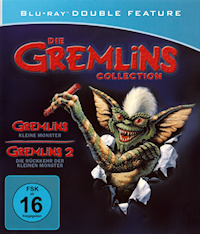
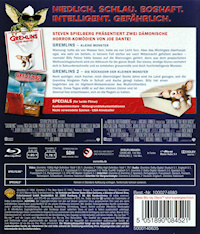
Gremlins and its sequel were originally released on DVD in one of the first batches of discs available at the start of the format as a feature-less affair. They were later followed up by special-edition re-releases in the early 2000s with restored transfers and very nice extras headed by entertaining audio commentaries, deleted scenes and more. When Warner chose Blu-Ray over HD-DVD in the brief HD format war, Gremlins and Gremlins 2 were in the first wave released on the new format – with the same extras as on the old DVDs but with new high-definition transfers that looked better and cleaner than before. This German release of the Gremlins Blu-Ray has a copyright date of 2012 on the cover but seems to have been authored in 2009. It is sold separately and also in the 2-pack “Gremlins Collection”, although these are the same discs. Despite its age, this release can still hold up and is probably only slightly overshadowed by the 2019 UltraHD release. |
   |
|||
|
Warner’s second digital transfer of Gremlins that appeared on the 2002 special edition was already looking pretty good but for the 2009 Blu-Ray release a new high-definition transfer was created that improved it a lot. The film source was in a much better shape than in the previous transfer. Except a few instances of dirt in the upper part of the opening credits, the transfer was cleaned very well with absolutely no scratches or other damages visible anywhere. The film grain was, however, largely left intact and is more or less visible depending on the lighting with dark scenes a bit more grainy. The analog film look is very nicely preserved on this Blu-Ray. Very much improved are also the colours. Everything looks more vibrant with better contrast and more balanced brightness especially in the many dark scenes which show a lot more detail. The image is also very stable without any frame instability that was still a problem on the older transfer. Sharpness and detail are okay but somewhat limited due to the film stock – it’s as good as a “flat” shot movie from the early- to mid-1980s should look. No visible sharpening or filtering was applied to artificially boost the image which makes it look very natural and not digital at all like some early Blu-Rays of that time. Overall this is a very nice transfer that still looks great on larger screens. The newer 4K version reportedly is somewhat sharper, but also has some colour problems and seems to be slightly zoomed in, so the Blu-Ray might be the better version. |
||||
|
The Gremlins Blu-Ray has a multitude of soundtracks, probably because Warner only made one disc master worldwide. Almost all languages are represented in 5.1 mixes but only the original English comes in Dolby TrueHD. Gremlins was originally mixed in two-channel matrix surround Dolby Stereo for the general release but Warner also made a few 70mm prints with 6-channel magnetic sound. Those were probably the basis for the 5.1 mixes that have appeared even on the first DVD release and have been further improved for the Blu-Ray. The English 5.1 mix is presented in Dolby TrueHD with 1365 kbit/s and sounds largely identical to the previous mix of the DVD, albeit somewhat clearer and more punchy. The original discrete sound mix already has a very nice soundscape for a 1984 movie when multichannel sound began to be really well utilized and this new mix doesn’t change that. With voices mostly anchored into the center channel the front soundstage is still very lively with sound effects and of course the music that also spreads over to the rear channels. Discrete surround effects are rare but when the Gremlins really get going so does the soundtrack, providing an immersive audio experience that is remarkable for a movie of this age. Bass and treble are excellent and even the voices, especially Hoyt Axton’s sonorous intro voiceover, sound very natural. There is also an English two-channel Dolby Surround mix with 192 kbit/s that sounds considerably flatter and while it decodes well in ProLogic, but has much less surround activity than the 5.1 track. It’s not a simple downmix of the 5.1 track but probably an archival version of the original Dolby Stereo track for the 35mm prints – a nice addition, but not necessarily good to listen to. The German, French, Italian, Castellano and Spanish tracks are probably the same mixes as the English 5.1 track but with the dialogue stems switched out. They are only encoded in Dolby Digital though, but at least with the maximum 640 kbit/s. Only the Portugese soundtrack comes in 1.0 Mono with 192 kbit/s, probably because a discrete dialogue track could not be found. There are also subtitles in all the languages of the audio tracks with additional subtitles in Dutch, Danish, Finnish, Norwegian and Swedish – but only for the main movie. The extras are not subtitled. |
||||
|
The worldwide Blu-Ray releases of Gremlins have almost exactly the same extras as the 2002 DVD release that was billed as a special edition. While no new documentary was produced, two fantastic commentary tracks, a short featurette, and ten minutes of previously unreleased footage truly deserve the “Special” label and do not disappoint. The only letdown are the menus of the Blu-Ray, because there is not even a proper main one – only a popup menu for the settings and a one-page listing of the special features. The crown jewels of the extras are the two Audio Commentaries, labeled “Filmmaker’s Commentary” and “Cast & Crew Commentary” in the menus. Director Joe Dante, producer Michael Finnell and special effects artist Chris Wales provide the first track, focusing primarily on the technical aspects of the filming. Anyone expecting dry, technical jargon will be disappointed – Joe Dante and Michael Finnell had already demonstrated their highly entertaining storytelling skills on the commentary track for Innerspace and here they reminisce with great enjoyment about virtually every facet of the film’s production. From the first, much more violent script drafts to Steven Spielberg’s regular checks and technical problems with the Gremlins puppets, everything is included – especially regarding the latter, “puppet master” Chris Walas has quite a bit to say. The second commentary track is again led by Joe Dante, but this time actors Phoebe Cates, Zach Galligan, Dick Miller, and Howie Mandel, the voice of Gizmo himself, join in. This track is even more lighthearted than the first, offering more anecdotes and other funny moments. Joe Dante, Zach Galligan, and Howie Mandel handle the lion’s share of this track, while Phoebe Cates seems rather bored, and Dick Miller simply can’t remember anything – the latter eliciting a few good-natured laughs. After about an hour, the participants start to tire, resulting in longer pauses, which are made up for by the end of the film. Despite Joe Dante’s presence on both audio commentaries, there is very little overlap, so both tracks are worth listening for the sheer entertainment value. The Behind the Scenes Featurette (6:21) is exactly what it says it is – a vintage 1984 promotion of the movie, but not overly commercialized. In fact it’s a compilation of some old interviews and set footage from the filming on the Chinatown set, along with a slightly tongue-in-cheek explanation of what Gremlins actually are. The director and some of the actors speak briefly, as does a grinning young Steven Spielberg, who apparently wasn’t entirely comfortable in his role as executive producer. It’s certainly not a proper documentary, but despite its short runtime, it’s a nice historical document that doesn’t feel out of place here. A total of eight additional scenes are included. Over ten minutes of footage were unearthed for this DVD, and Joe Dante, Michael Finnell, Zach Galligan, and Phoebe Cates even recorded an optional audio commentary for these scenes. The scenes are well preserved and presented in their original aspect ratio but sadly only in 4:3 letterbox 480p. Among them are two subplots featuring the bank manager and Judge Reinhold’s character, which could have easily been integrated back into the film. It’s not just leftover footage from the editing room; there’s some genuinely worthwhile material included. Three Trailers were selected as promotional material : the theatrical and reissue trailers for Gremlins and also one for Gremlins 2, all now presented in anamorphic 480p but not re-transfered in HD like the deleted scenes. While the biographies and production notes from the DVD have been left off the Blu-Ray there is now a Photo Gallery containing about 20 production photos in both colour and black and white, but only in a very small format |
||||


 The Movie