 Time Bandits |
||||
|
Title | Time Bandits | ||
| Studio | Time Bandits (1981) | |||
| Released by | Arrow Home Video (2013) | |||
| Disc Type | BD-50 (44.5 GB) | Bitrate | ø 35 max. 40 | |
| Runtime | 115:55 Minutes | Chapter | 12 | |
| Region | B (England) | Case | Amaray | |
| Format | HD 1080p24 AVC | |||
| Image | 1.85:1 | 16:9 |  |
|
| Sound |  HD-Master  English PCM  English |
|||
| Subtitles | English | |||
| Rating | BBFC PG | |||
| Extras | • Chasing Time Bandits • Writing the film that dares not to speak its name • The Effects of Time Bandits • Playing Evil • The Costumes of Time Bandits • The Look of Time Bandits • From Script to Screen • Original Trailer • Restoration Demonstration • Collector’s Booklet |
|||
|
Eleven-year-old Kevin gets the fright of his life when a knight on horseback gallops out of his closet one night and disappears again. Since his parents are only interested in their lifestyle, which consists of the latest household gadgets, Kevin lies in wait the following night, armed with a flashlight and a Polaroid camera. To his astonishment, he is ambushed by a horde of six dwarves, who initially mistake him for someone they are fleeing from. A mysterious figure chases the small group, and Kevin follows them through a shaft he’s never seen before, where his bedroom wall should be… Terry Gilliam, the only American member of the British comedy troupe Monty Python, was primarily responsible for the surreal cartoon interludes in their Flying Circus television series, which quickly became a trademark of the cheeky comedy-satire series. After their first feature film, Monty Python and the Holy Grail, which Gilliam co-directed with his colleague Terry Jones, the seven group members gradually began to pursue separate paths. Following a final, short season of the Flying Circus, Monty Python didn’t disband, but got on an unofficial hiatus. Terry Gilliam had developed a taste for filmmaking and in 1977 attempted his first solo project, Jabberwocky. The dark medieval satire, filmed on a budget of just half a million dollars and starring Gilliam’s fellow Python, Michael Palin, served as a test case for the filmmaker’s unique style and already hinted at many elements of his later works. After that, Terry Gilliam, along with the other Monty Python members, was busy making their new film, The Life of Brian, although he left the directing to Terry Jones to avoid the conflicts that sometimes came up previously. The Life of Brian was released in 1979 and became Monty Python’s biggest – and most controversial – success. Following Jabberwocky and Life of Brian, Terry Gilliam began to consider a new solo project. It was to be a futuristic satire called Brazil, but he initially couldn’t find a studio interested in his idea and shelved it to pursue a more promising project – something less demanding and suitable for a wider audience. In just one weekend, the idea for Time Bandits was born, a fantasy comedy with the unusual tagline “for the whole family,” but also with the added caveat “intelligent enough for adults”. Terry Gilliam chose his Python colleague Michael Palin as his writing partner, as they had enjoyed working together on Jabberwocky so much that they now wanted to write a screenplay together. The story of a fantastical journey across time and the proverbial battle of good versus evil was told from a child’s perspective, but was very different from typical children’s movies. To ensure the main character wasn’t overshadowed and to maintain perspective, the time-traveling bandits were described as dwarves and were to be played by actors of short stature who, in Terry Gilliam’s opinion, finally deserved a real chance on the big screen. Terry Gilliam and Michael Palin initially tried to pitch their screenplay to a number of film studios, but without success. Ultimately it was George Harrison who came to the rescue again with his company Handmade Films that he had originally founded for Life of Brian. He personally provided an astronomical budget of around five million dollars – a fortune for the director, who had made his previous film Jabberwocky, for a tenth of that sum. With a brilliant script and secured financing, production on Terry Gilliam’s new movie could begin. Casting the lead role, eleven-year-old Kevin, wasn’t easy, as Gilliam wasn’t convinced by many of the young actors that were tested. He was looking for an ordinary, average boy and by chance, the filmmaker noticed Craig Warnock during the casting process, who had only come to the interviews only to accompany his older brother. Gilliam liked Craig’s shy manner so much that he chose him over all the others and entrusted him with the difficult role. With a uniquely disarming charm and a naturalness that many other actors his age lacked, Craig Warnock was ideal for the film’s lead role. Terry Gilliam didn’t have much choice when it came to casting the titular Time Bandits , as there were only a limited number of little people in England’s Showbusiness and finding six of them was a considerable challenge. David Rappaport, Kenny Baker, Malcolm Dixon, Mike Edmonds, Jack Purvis, and Tiny Ross had previously only appeared in minor supporting roles on stage and screen, usually in heavy costumes, but in Time Bandits they were given the rare opportunity to play real characters and clearly enjoyed it. Although the six characters form more of a collective ensemble role, Terry Gilliam endeavored to give each of them a distinct performance. While David Rappaport as Randall was the actual ringleader and got the most dialogue, all the others have their distinct characters even though the script unfortunately didn’t give them as much to say due to time constraints. To guarantee the film’s commercial success, some of the supporting roles had to be filled by well-known actors. A key role was cast by chance with Terry Gilliam’s dream actor: King Agamemnon was described in the script as resembling Sean Connery and luckily producer Dennis O’Brien happened to be playing golf with the former James Bond actor and mentioned Terry Gilliam’s new movie. Connery was immediately fascinated by the small, but crucial role and agreed immediately – and did not even demand an outrageous salary. Instead he just took a small fee and a percentage of the earnings. Connery also gave Gilliam some valuable tips during his short time on set. Even though Connery’s screen time can be measured in single digit minutes, he became the heart and soul of the movie and almost saved the whole production. The Evil Genius, a typical Gilliam interpretation of the devil, was portrayed by English stage actor David Warner after Jonathan Pryce, who later starred in Brazil, declined the role because he got a better offer from another movie production. Warner, who had started his career in the early 1960s with the Royal Shakespeare Company and already had a long history of movie and television appearances made the character far more than just a one-dimensional villain. His Evil Genius is not just simply evil, but has a delightful organizational madness behind him. For the somewhat delicate role of the Supreme Being, Terry Gilliam managed to secure a true English theatrical legend: Sir Ralph Richardson played the divine character with a wonderfully dry, humorous undertone. He only appears in the final moments of the movie but leaves a lasting impression with his genial appearance as a slightly befuddled and benevolent schoolmaster who turns out to be the whole reason for the events of the movie. Other historical figures were similarly aptly cast: Ian Holm gives a superb performance as Napoleon Bonaparte with a height fixation in one of his best roles. Terry Gilliam also got his fellow Monty Python to appear as a delightful Robin Hood parody à la Errol Flynn with a completely British looney attitude. Michael Palin also did not only co-write the script, but also took on two small, related supporting roles together with British actress Shelley Duvall, which are more like little Monty Python-esque sketches. Gilliam also had the fortune to cast two very memorable characters in the Time of Legends segment with excellent actors: the ship-bound ogre couple. While Mrs. Orge was originally to be played by Gilda Radner, who had just concluded her five-year-run in Saturday Night Live, Gilliam chose Katherine Helmond who had appeared in the very successful satire comedy show Soap. Her appearance as the oblivious and loving spouse to the ailing monster is wonderful and British theatre and cinema veteran Peter Vaughan at her side as the elderly ogre plagued with health problems is equally amazing. The busy, but relatively unknown television actors Sheila Fern and David Daker are perfect as Kevin’s boring, middle-class parents who are more interested in the glory of their household appliances. A surprise is Britsh actor Jim Broadbent as the flamboyant showmaster who Kevin’s parents are watching on TV. All three are making a short comeback in the finale of the movie. Time Bandits jumps wildly through time in its first half, because Terry Gilliam and Michael Palin had crammed not just one historical epic, but several into the film at once. Despite the relatively low budget for such an elaborate production, great emphasis was placed on an attractive production design, making the sets and costumes of Napoleonic France, ancient Greece, and medieval England look at least halfway realistic. Historical inaccuracies, however, were accepted and even intentional, as the film was meant to show the world from the perspective of an eleven-year-old boy. Due to the film’s almost-but-not-quite Hollywood budget, the special effects had to be achieved with clever tricks. Computer graphics were completely out of the question in 1981, so most of the film was shot using traditional methods. Despite the science fiction theme, relatively few optical effects were used, relying instead on models, camera tricks, and cleverly designed sets. The actual visual effects were produced by Peerless Camera, a studio founded by Terry Gilliam in the late 1970s, and despite their literally handmade nature, they didn’t look cheap at all. As producer and financier, George Harrison initially wanted to score Time Bandits with his own compositions, but Terry Gilliam, with the help of co-producer Dennis O’Brien, largely managed to curb this. Due to scheduling conflicts, the ex-Beatle ultimately only had time to compose a single, but memorable song for the film’s end credits anyway. The main score was written by keyboarder, producer, and composer Mike Moran. His film music relied on a clever mix of synthesizer-heavy science fiction sounds and traditional orchestral arrangements, stylistically guiding the film through its various historical periods. The themes may be not as original and catchy as George Harrison’s end-credits, but they contribute a lot to the playfulness of the movie and range from lighthearted, dramatic and terrifying – and are a lot of fun. Thanks to Terry Gilliam’s rarely seen combination of fantasy, historical epic, science fiction, and fairy tale, Time Bandits worked on several levels: children could best identify with the young protagonist and enjoy the film’s slapstick humor, while adults recognized the satirical and parodistic elements. For Monty Python fans, Time Bandits was a true delight, as Terry Gilliam could hardly conceal his origins in any of his early films. Time Bandits is perhaps the unintentionally most python-esque movie of Gilliam’s career. The perfectly balanced mix of genres didn’t automatically guarantee Time Bandits’ immediate success, as the finished film was only released in British cinemas by Handmade Films in the summer of 1981. Despite considerable success in England, it took almost six months before a distributor could finally be found for the lucrative American market. All the major studios had rejected the film as too complex, but the small distributor Avco Embassy Pictures gave Time Bandits a chance. They saw an opportunity and even invested a considerable amount in advertising and promotion – with astonishing success: on its opening weekend alone, Time Bandits recouped its production costs in just over 800 cinemas and grossed over $40 million in the US alone. It took some time before distributors were found in other countries. Time Bandits arrived in Germany in the spring of 1982 and, thanks to the success of Monty Python and the Holy Grail and The Life of Brian, was enthusiastically received by audiences. This was particularly remarkable in Germany because Terry Gilliam had insisted that his film be advertised entirely without the Monty Python moniker – primarily in Europe, which made his fantasy tale his most successful film to date. Time Bandits also marked the beginning of a loose trilogy of films for Terry Gilliam, depicting the adventures of a child in Time Bandits , an adult hero in Brazil, and an old man in The Adventures of Baron Munchausen. While the movies are not connected with each other except for the age progression of the main character, stylistically they are unmistakably linked. Terry Gilliam and his writing partner Charles McKeown once even planned a sequel in the mid-1990s, but with most of the Time Bandits actors, especially David Rappaport, Jack Purvis and Tiny ross having passed away, the idea was abandoned. A short-lived Apple TV series in which Gilliam had no input was cancelled after one season. The original movie still remains one of the most amazing fantasy adventures in cinema history.
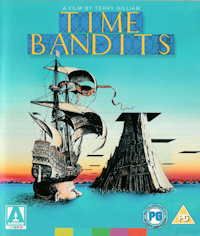
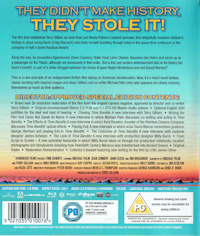
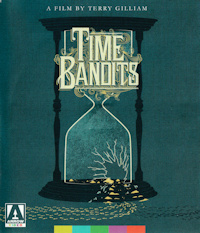
Time Bandits has a long and somewhat torturous history on home video, because the rights seem to bounce around a lot especially in Europe. The first proper home video release was from the Criterion Collection in 1997 on Laserdisc and two years later on DVD with a less than stellar transfer, but at least with a worthwhile audio commentary. Anchor Bay released a new DVD in 2004 with a new anamorphic transfer and some extras, but wasn’t able to get the commentary from Criterion. In the following years there were several re-releases on DVD in all regions, but no new Criterion edition until 2014, when the movie was finally released on Blu-Ray in Region 1. This disc was based on a new digital 2K restoration that Arrow Video made from the original negative in 2013 and released on a British Blu-Ray that year – again without the audio commentary, but with a very nice selection of new interviews and other extras. Ten years later Arrow and Criterion both followed up with a 4K release. Because there were also a few German Blu-Rays about whose quality I was unsure, I was specifically looking for the UK Arrow release because importing the Criterion from the US is difficult and expensive. Luckily I was able to get a used disc that turned out to be a very nice upgrade to my old 2004 AnchorBay DVD – it even has two different designs on a double sided cover. Save for the 4K release from Arrow and Criterion, this is the best version of Time Bandits. |
    |
|||
|
For probably the first time, Time Bandits was transferred by Arrow Video and Deluxe UK from the original camera negative in 2013 – with amazing results. The disc still contains a warning that there are limits and imperfections inherent in the film material, but those are so minuscule that they are hardly noticeable. The restoration featurette in the bonus materials shows how much work went into this transfer. The negative has been extensively digitally cleaned, there are no scratches, dirt or dust visible anywhere. The film grain was also thankfully not filtered out at all and is constantly more or less visible, making this transfer look like a proper analog film projection. Sharpness is excellent and doesn’t have to rely on a filter at all, because the first-generation film source is very detailed – some occasional softness is just the way the film originally was shot. The colour timing of Time Bandits has always been tricky and has been interpreted differently on each transfer – but the Arrow version really gets it right this time. It’s quite similar to the 2004 DVD with a couple of tweaks and the gloomy reds and browns of the very old Criterion laserdisc master have now been entirely eliminated. Skin tones look very realistic and contrast and brightness have been perfectly balanced, so that more detail is visible in dark scenes. This Blu-Ray is a wonderful preservation of the movie, Time Bandits has never looked better. |
||||
|
Arrow has also done the right thing with the soundtracks by remastering the original soundtrack and also including a multichannel upmix – although because it’s an UK-only release there are no other languages included. The original Dolby Stereo two-channel mix in uncompressed PCM audio is largely identical to the previous releases and an excellent mix for its age. For the 2013 Blu-Ray it was remastered again from the original magnetic tracks and sounds even better than before. The front soundstage is very wide and is utilized by music, dialogue, and sound effects right to the corners. The surround channel is primarily used for the music, but also frequently for specific effects or ambient sounds. Voices sound very natural, although some dialogue sounds a bit muffled because it appears to have been recorded live on set and never dubbed in a studio. There’s only a slight background hiss, and while the frequency response isn’t exactly thrilling, it boasts a rich bass and only dips slightly in the treble. The dynamics aren’t quite as lively as in more recent films and are more focused on sheer volume in crowd scenes. Overall, however, this soundtrack is a prime example of a Dolby Stereo mix of the early 1980s. While the 5.1 remix on the old Anchor Bay DVD was a terrible mess, Arrow has taken a more gentle approach for the DTS HD-Master 5.1 mix that is an exclusive to the British release and does not appear on the US Criterion disc. The upmix sounds less forceful and loud with better dynamic and separation, but also has a little more bass and treble. Overall, it sounds somewhat more modern with an even wider frontal soundstage and more emphasis on the surround effects. The differences are not huge but it’s nice to have both soundtracks on the Blu-Ray. There are also English subtitles for the main movie and all the extras available. |
||||
|
While Arrow Video was not able to license the commentary track from Criterion, for the first time a studio took the trouble to produce a new collection of extras for Time Bandits. The bulk of the bonus material consists of a series of new interviews that together actually make a solid new 90-minute documentary, more than on any other release. Chasing Time Bandits (20:07) has director Terry Gilliam remember the making of his movie in great detail and quite a few anecdotes. Writing the Film that dares not speak its name (16:05) is co-writer and actor Michael Palin’s interview in which he tells about his writing collaboration with Terry Gilliam and his two small appearances in the movie. The Effects of Time Bandits (15:28) with Kent Houston, founder of Peerless Camera Company, takes a fascinating look at the visual effects of the movie and also at the beginnings of the effects house. Playing Evil: David Warner (8:43) is a short, but nice interview with the actor who sadly passed away in 2022, remembering one of his more unique roles. The Costumes of Time Bandits (13:21) had British costume designer James Acheson not only talk about his versatile work on Time Bandits, but also show off some of his original concept drawings. The Look of Time Bandits (10:43) has production designer Milly Burns take a look back at the unique design of the movie, followed by From Script to Screen (8:33) where she shows her concept drawings in comparison to the finished movie. The Trailer (3:09) is presented in 1.33:1 and somewhat dubious quality, but it’s the usually funny Terry Gilliam style. The Restoration Demonstration (2:43) with James White from Deluxe UK takes a somewhat dry, but visually interesting look at the restoration – we even get a look at some scenes from the complete unrestored camera negative. |
||||


 The Movie
 Bonus Materials