 The Sting |
||||
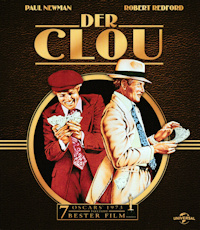
|
Title | The Sting (Der Clou) | ||
| Studio | Universal Pictures (1973) | |||
| Released by | Universal (2012) | |||
| Disc Type | BD-50 (42.8 GB) | Bitrate | ø 35 max. 40 | |
| Runtime | 129:10 Minutes | Chapter | 16 | |
| Region | ABC (Germany) | Case | Amaray | |
| Format | HD 1080p24 AVC | |||
| Image | 1.85:1 | 16:9 |  |
|
| Sound |  HD-Master  English, Japanese  German, French, Italian, Spanish |
|||
| Subtitles | English, French, Italian, German, Spanish, Chinese | |||
| Rating | FSK 12 | |||
| Extras | • The Art of The Sting • 100 Years of Universal: Restoring the Classics, The 1970s, The Lot |
|||
|
Johnny Hooker (Robert Redford) is a small-time pickpocket in 1930s Chicago. When he and his friend and mentor Luther (Robert Earl Jones) accidentally steal $10.000 from a courier working for gangster Doyle Lonnegan (Robert Shaw), Lonnegan doesn’t hesitate to have Luther murdered. Hooker flees to Chicago to an old friend of Luther’s, washed-out master thief Henry Gondorff (Paul Newman). With Gondorff’s help, Hooker plans to get revenge on Lonnegan – but it will take some preparation and all of Gondorff’s skill to teach the dangerous gangster a lesson. The Sting is one of the few movies that has been an undisputed classic since its premiere. It gave the impression of being an old-fashioned, sprawling production from the good old days of Hollywood in the 1940s or 50s, but the exact opposite is true. The movie was the work of an entirely new generation of young, independent filmmakers who were beginning to establish themselves in the early 1970s and had little to do with the old Hollywood studio system. It all began as an idea of the young writer David S. Ward, who was researching a pickpocketing scene for a screenplay and soon became interested in the world of small-time con artists, the Chicago grifters of the 1930s. Along with his screenplay for Steelyard Blues, Ward presented the initial concept for The Sting to producer Tony Bill, who brought the husband-and-wife production team of Michael and Julia Phillips on board and gave Ward the green light to further develop his new idea. The story of two small-time crooks who attempt to bring down a gangster boss with the help of a large-scale betting fraud was largely inspired by the 1940 book The Big Con, in which linguistics professor David W. Maurer examined the world of con artists in the 1920s and 30s. Ward based his main characters Johnny Hooker and Henry Gondorff on the brothers Charley and Fred Gondorff, who were active in Chicago and surroundings around 1915 and, at the height of their careers, pulled off a very similar large-scale scam to the one depicted in his story. Richard Zanuck and David Brown, who had recently founded their own independent production company, were enthusiastic about Ward’s screenplay and agreed to put up the production at Universal Pictures. Up to that point, no director was involved yet – but that quickly changed when George Roy Hill stumbled upon the script while working on the post-production of the Kurt Vonnegut adaptation Slaughterhouse Five. Hill was enthusiastic about Ward’s script and immediately showed it to Paul Newman, with whom he regularly exchanged ideas. Since David Ward had written one of the two main characters with Robert Redford in mind, this presented an opportunity to reunite the dream team of Redford and Newman, who had starred in George Roy Hill’s surprise hit Butch Cassidy and the Sundance Kid in 1969. Initially, Jack Nicholson was slated for the role of Johnny Hooker, but only when he declined Hill approached Robert Redford, who had also previously turned down the role but ultimately accepted thanks to the director’s persuasion. David Ward’s complex and multifaceted screenplay featured an above-average number of characters, all perfectly cast. With a brilliant script and the support of Universal, the filmmakers managed to attract many excellent actors. What looks like a star-studded cast today was a necessity at the time, because with a budget of five and a half million dollars, they couldn’t afford the biggest stars – instead, they found excellent character actors who best suited the sophisticated characters in the script. Even Robert Shaw as the icy gangster Dolye Lonnegan, only got his role after another actor had turned it down – and Shaw himself almost declined because he sprained his foot shortly before filming began. George Roy Hill liked Shaw’s limp so much that he cast him despite the injury, giving Lonnegan a physical disability that made him even more dangerous, unpredictable, and charismatic. The many supporting characters, both large and small, were cast with as much care as the main roles. The meticulously detailed characters in David Ward’s screenplay made finding the right actors a challenge, but the selection was nonetheless exceptional. Robert Earl Jones appears in a small but memorable role as Hooker’s mentor, Luther Coleman, and the corrupt and corpulent cop Snyder is portrayed delightfully sleazy by Charles Durning, who a year later played a reporter in Billy Wilder’s The Front Page, a similar period piece. Equally successful was the casting of Hooker and Gondorff’s circle of friends. From Harold Gould as the gentleman con man Kid Twist, to the shrewd handyman JJ Singleton played by Ray Walston, to Jack Kehoe as Hooker’s former partner Eerie Kid, the actors are consistently brilliant. Even smaller supporting roles, such as Charles Dierkop as Lonnegan’s silent bodyguard Floyd, Dana Elcar as FBI agent Polk and many others, are just as remarkable and memorable as all the other characters. Surprisingly the casting was not only an all-male affair – two of the most compelling roles were female. Eileen Brennan plays Gondorff’s girlfriend Billie, who is far more than just a dim-witted gangster’s moll, and Dimitra Arliss appears as a mysterious waitress in a gloomy restaurant. These are small but impressive roles, not merely decorative additions, but important characters who have a significant impact on the plot. Originally, The Sting was supposed to be filmed in and around Chicago, but not enough historical locations could be found. Long-time mayor Richard J. Daley also disliked filming in his city that didn’t portray it in a positive light. So only a few isolated scenes were filmed on location and the rest was shot in the Universal Studios lot in Hollywood, where production designer Henry Bumstead had entire city blocks meticulously reconstructed to make the film look as authentic as possible. The film’s overall appearance was so perfectly crafted that it looked like the filmmakers had traveled back in time to 1930s Chicago. Without the support of a major studio like Universal, this would hardly have been possible, as the numerous historical sets on the studio lot were perfectly suited for The Sting. The fake Chicago probably even looked more authentic than the real thing, but some old-fashioned matte paintings also referenced the vintage look of films from the 1930s and 40s. David Ward’s screenplay was at least as complicated as the film’s set design, if not more so. The main story, which is actually quite straightforward, was accompanied by a whole host of subplots that repeatedly tries to confuse the audience and features many surprising twists. Right up until the end, it’s not entirely clear who really deceived whom, and how – yet The Sting doesn’t strangle itself with its seemingly convoluted plot, because for attentive viewers, some clues are hidden throughout the film that make the twists less enigmatic. Although the story is set in the midst of the Great Depression, the film’s tone remains largely light and positive, even though it is essentially a drama. The humor is deeply woven into the plot and never feels forced; there’s hardly anything to laugh out loud, but plenty to smile at. The story takes itself quite seriously, as the entire film strives for authenticity and atmosphere, and it succeeds in being wonderfully entertaining precisely because of its real-life setting. Hooker and Gondorff are the lovable crooks who wouldn’t hurt a fly and only steal from those who deserve it. The image of grifters and con men is, of course, clearly romanticized and downplayed in The Sting, but David Ward has nevertheless very effectively captured the principle and philosophy of these non-violent, perfectly organized thieves. It’s not primarily about money, but about a particular kind of revenge – Hooker initially prefers to kill Lonnegan, but Gondorff teaches him how to inflict a far more effective punishment on the gangster. The Sting owes much of its fame to its unique film score. Screenwriter David Ward originally wanted to use blues music from the 1930s and 40s, but George Roy Hill had a completely different idea: as a pianist, he was very fond of Scott Joplin’s ragtime melodies, which he considered ideal for the film’s mood. David Ward initially protested that the ragtime music was at least ten to fifteen years too late for the 1930s, but George Roy Hill countered that hardly anyone would notice. However inaccurate Scott Joplin’s pieces are for 1936, they proved highly effective in creating the film’s atmosphere. It’s also noteworthy that the music is never used as mere accompaniment, but is almost always heard without any background noise or dialogue. For the arrangement of Scott Joplin’s ragtime pieces, which were still relatively unknown in the early 1970s, the filmmakers turned to composer Marvin Hamlisch, who was also an accomplished pianist and a fan of old jazz music. Hamlish recorded some of the pieces solo on the piano himself, and others with a small orchestra, largely assembled according to the model of early jazz combos and consisting mainly of brass instruments. The piano arrangements remained quite faithful to Joplin’s original recordings, preserved for posterity on Edison phonograph rolls, but were played with great sensitivity by Hamlisch and are among the finest Scott Joplin interpretations in existence. Unfortunately, for The Sting only a handful of pieces were recorded and some were even shortened. For example, the beautiful B section of The Entertainer is missing, although it still made history as the film’s theme music. The Sting led to the rediscovery of Scott Joplin’s ragtime pieces, and the film score even made it into the charts. Despite their incompleteness, these recordings are outstanding, but it still would have been amazing if Hamlisch had recorded more Joplin pieces in this way. Inspired by the success of The Sting, Itzhak Perlman and Andre Previn did just that in 1975, arranging ten Joplin compositions for piano and violin and releasing them as The Easy Winners album. The filmmakers and actors were firmly convinced that The Sting would be a success, but no one really expected the film to gross over $100 million at the box office and win seven out of ten Academy Awards in 1974. The film was a springboard for many involved, enabling them to achieve one of the biggest surprise successes of the decade. For Robert Redford, after his initial successes in the 1960s, it marked the beginning of a distinctive Hollywood career that continued until his retirement and Paul Newman celebrated a major comeback with The Sting. The Sting wasn’t your average popcorn movie at all, but rather perfectly choreographed, intelligent entertainment with an incredible energy that made its two-plus-hour runtime fly by. There were many imitators, but none could match the original – not even David S. Ward’s sequel, The Sting II, ten years later, which failed more due to the unfortunate recasting of the lead roles than because of the idea itself. To this day, The Sting remains one of the best heist comedies in film history and, unlike many other films of its time, has hardly aged – it’s the nostalgia that keeps the story fresh, vibrant and fun.
After Universal missed the opportunity to produce a 30th-anniversary DVD in 2003, a new edition of The Sting finally appeared in the US in 2005 under the Legacy Series banner as a Special Edition. While this reissue did not have a lot of extras save for an hour-long documentary, the image and sound quality were a vast improvement on the older versions. An HD DVD of the Legacy Edition was also released in 2008, but after the format’s rapid demise, Universal didn’t release a Blu-ray until 2012. The worldwide Blu-Ray release of The Sting, four years after the HD-DVD version of the Legacy Series, surprisingly came with another completely new transfer that fixed a few problems of the earlier incarnation and looks just great. Despite the somewhat lackluster presentation without a proper menu and no new extras, this is a very nice disc. There is also a 2021 4K release available, but this Blu-Ray release is a pretty good representation of the movie. |
  |
|||
|
For a long time, The Sting had only been available in fullscreen in the US and in Europe only in low-resolution non-anamorphic widescreen on DVD. Universal had finally changed that with a brand-new transfer in the original format for the Legacy Series and improved it even more with the 2012 Blu-Ray version. Rumors that The Sting was supposedly filmed in 1.37:1 and later cropped to 1.85:1 against the director’s wishes are completely unfounded, as the image composition is clearly designed for widescreen – the old fullscreen transfers not only lost quite a bit of image at the sides but also have a distinct television look, which disappears immediately with proper widescreen framing. The 35mm film source was thoroughly digitally cleaned and all the scratches and dust that were even still visible in the Legacy Edition. The grain has been largely left alone to preserve the intentional gritty look of the movie – reports of overzealous noise filtering are absolutely not true. While the grain looks softer than in the previous transfers, it is still very much present in a healthy amount and does not look filtered at all. Sharpness is quite good for a movie shot in the early 1970s but is not exceptional, which might be an intentional result of the film stock to achieve a vintage look. The transfer is so detailed that a slight deterioration in image quality can be noticed around the transitions and optical effects that has always been a part of the movie. The slight unsteadiness of the image on the older DVD transfer has also now been fixed, the image is now very stable The new color timing is truly impressive. The Sting has always had a somewhat vintage look even for the early 1970s, but here the vintage warm, brownish-red color palette with its many colorful splashes has finally been captured correctly without looking faded or old. Instead it looks like an early three-strip Technicolor production from the 1930s. This 2012 Blu-Ray transfer does everything right and thanks to a high bitrate the compression is also absolutely invisible. While the 4K might have the edge on the resolution, the movie has never looked better than on this disc. |
||||
|
An even bigger surprise than the new transfer is the audio. The amazing 5.1 remix from the Legacy Series has been re-encoded in DTS-HD Master Audio for the Blu-Ray, but the English Mono track has been dropped. The new 5.1 track isn’t a simple upmix of a mono source, but a complete remix that utilizes the existing stereo recordings of the film score. A large portion of the music was actually discreetly remixed, allowing the individual instruments to make broad use of the front soundstage and also utilize the surround channels to some extent. Some parts of the score, mainly in the second half of the film, was stereoized from mono sources because these tracks had not included on the soundtrack album in this version – but this has been done so well that it’s barely noticeable. Most astonishing is the qualitative difference between the music in the 5.1 version and the mono track – in terms of dynamics and frequency range, the two versions are worlds apart. Marvin Hamlish’s ragtime piano playing of Scott Joplin’s melodies no longer sounds like a shaky pub piano, but like a concert grand and the other instruments also sound much clearer. This is the way the music was supposed to be heard. Voices and sound effects have also been significantly improved in the 5.1 audio track. The dialogue now sounds remarkably warm and distinct, and the ambient noise has been carefully integrated into the surround sound mix, resulting in a very natural sound. Direct surround effects are, of course, used only very sparingly, so most of the action takes place on the front soundstage. Nevertheless, the mix is so active that it’s more than just a mono track with stereo music. Sadly, the original restored English mono track has not been included on the Blu-Ray but in the end this is a good choice because the remix is really good and authentic. All languages including the German version are only available in unrestored DTS 2.0 Mono, but astonishingly there is a Chinese 5.1 version in DTS-HD-MA available too. |
||||
|
For a special edition originally titled Legacy Series, Universal has put surprisingly little effort into the bonus material. The pretty menus from the DVD are completely absent on the Blu-Ray, which has just the standard sterile HD menus that are used on many early Universal discs. The Art of The Sting (56:14) is a three-part documentary with the sections The Perfect Script, Making a Masterpiece and The Legacy that was originally produced for the Legacy Series DVD. It’s less a sophisticated documentary and more a collection of recent interviews with the actors and filmmakers, who reminisce about the making of the film with much humor and a twinkle in their eyes. Robert Redford, Paul Newman, Charles Durning, Eileen Brennan, Dimitria Arliss, Ray Walston, Marvin Hamlish and David Ward all appear; only director George Roy Hill, who passed away in 2002, is sadly absent. While the interviews are highly interesting and entertaining, they are unfortunately edited together somewhat uninspiredly and are too often interrupted by excessively long film clips. Stylistically, much more could have been done with this documentary, but at least a lot of stories are told firsthand by the consistently charming and witty actors and filmmakers. The Theatrical Trailer (2:13) in non-anamorphic 480p widescreen is not an original trailer, but rather a re-release from after the Oscars. 100 Years of Universal: Restoring the Classics (9:13), The 1970s (11:01) and The Lot (9:25) is a little collection of featurettes celebrating the studio’s anniversary. |
||||


 The Movie