


 The Martian [Extended Edition] The Martian [Extended Edition] |
||||
15.8.2026 |
Title | The Martian | ||
| Studio | 20th Century fox (2015) | |||
| Released by | 20th Century Fox | |||
| Disc Type | 2x BD-50 | Bitrate | ø 35 max. 40 | |
| Runtime | 141:37 / 151:20 Minutes | Chapter | 17 | |
| Region | ABC (UK) | Case | Amaray | |
| Format | HD 1080p24 AVC | |||
| Image | 2.39:1 | 16:9 |  |
|
| Sound |  HD-Master HD-Master  English English  Spanish, French Spanish, French  Commentary Commentary |
|||
| Subtitles | English, Spanish, French | |||
| Rating | BBFC 15 | |||
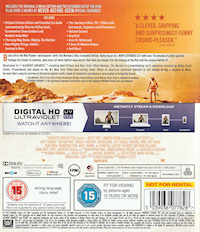
| Extras | • Original Cinema Edition and Extended Cut • Audio Commentary by Director Ridley Scott, Screenwriter Drew Goddard and Novelist Andy Weir • The Long Way Home: Making the Martian • Dare Mightly Things: NASA’s Journey to Mars • The Journey to Mars 101: 3 Q&A’s with Astronauts, Engineers and Filmmakers • Deleted Scenes • Gag Reel • Ares III Mission Videos • Trailers |
|||
|
The Ares III mission is not the first or the second crew to land on Mars in the year 2035, but the third – so everything has become less exciting and more routine. Well into their mission of exploring their target area, the crew is surprised by a large dust storm brewing near their habitat. The bad weather arrives so fast that it threatens to topple their return spacecraft and they are forced to evacuate. On their way from the habitat to the rocket through the blazing storm, mission botanist Mark Watney gets hit by flying debris and his crewmates try to find him – but to no avail. As the storm gets worse, they have no choice to leave without him, presuming him dead. But hours later after the storm has passed, Watney wakes up injured – but alive… The Martian has had a rollercoaster of a career both as a book and a film. It all started at the end of the 2000s, when Andy Weir, a computer programmer by profession and then just an amateur writer, began to work on a novel about an astronaut stranded on Mars after an accident forces his crew to leave him behind. The idea had its roots in the classic science fiction of the 1950s and 1960 Weir grew up with, but he aimed to make his story less fiction and more fact by getting all scientific details exactly right – which often involved advanced orbit calculations, chemistry, biology and even Martian geography. Despite his efforts, Andy Weir had initially not even thought about offering the story to a publisher and instead began releasing it on his own website as a serial for free. Only after his readers asked him to release The Martian as an e-book, he uploaded it to the Amazon Kindle platform for the minimum price of 99 cents and to his great surprise it was bought more than 35000 times, more than it had been previously downloaded for free from his website. Andy Weir had struck a nerve with his readers and as The Martian began to get noticed on Amazon, publishers also started to get interested. Surprisingly, the novel did not make it into print at first, but was produced as an audiobook by Podium for Amazon’s Audible platform in early 2013 and only then the ball started to roll properly. Crown approached the author through literary agent David Fugate, who brought The Martian to the publishing house. Because the novel had never been properly edited, it was slightly improved and the audiobook, almost a full production expertly narrated by R.C. Bray, was also re-recorded for an early 2014 release. The Martian had finally arrived in its final book incarnation – but there was more to come because at the same time, the movie rights were quickly snapped up by 20th Century Fox. The Martian was by far not the first serious Mars exploration novel, but still managed to be completely fresh and original. Especially Kim Stanley Robinson and Gregory Benford had already written extensively about crewed Mars missions, but had always focused more on science fiction than reality, something which Andy Weir approached quite differently. His vision of the future Mars exploration was much more based on the present than any other previous stories and while the actual plot focused on the survival of a lone astronaut, the author took this as a scientific example to demonstrate how this could be achieved by including lots and lots of very accurate technical details. While this made The Martian unique, the complexity of the novel made it not automatically a prime candidate for a movie adaptation. Although the movie later became famous as a Ridley Scott production, it didn’t start out as one at all. Producer Simon Kinberg, who had been tasked by Fox with the development of the movie, had originally brought the novel to the studio together with Drew Goddard, who was then attached to the project as both author and director. While the script was being developed in 2014, Goddard chose to continue as writer, but bowed out as director because he had a chance to direct a movie about Marvel’s Sinister Six – ironically a project that was later cancelled. Nevertheless, Kinberg had to find a replacement for Drew Goddard, which was not easy because there was a lot at stake and the setting of the story alone was something that almost approached box office poison. After a whole string of high-profile flops, Mars movies had become somewhat unpopular in Hollywood. Both Brian de Palma’s Red Planet and Antony Hoffmann’s Mission to Mars sported huge budgets and big casts, but failed miserably both critically and commercially when they were released in 2000. Even Disney’s John Carter, an expensive adaptation of Edgar Rice Burrough’s Mars novels, became a huge flop and after that, the red planet was something no director really wanted to touch anymore. But the recent successes of space exploration movies like Gravity and Interstellar made space popular again and since The Martian relied more on fact than fiction, it attracted a lot of attention even though the novel was initially deemed unfilmable. There were a lot of rumours about who would direct The Martian and two names frequently popped up in the speculations: James Cameron and Ridley Scott. Cameron would actually have made sense because he is a known space enthusiast and a big supporter of future Mars missions, but being busy with other projects he had no interest in directing The Martian. Ridley Scott was, however, so intrigued by the work already done on the script that he reportedly even postponed the production of his Prometheus sequel to immediately join The Martian at the request of producer Simon Kinberg. Scott was by no means a foreigner to the space and science-fiction genre, having practically invented the space horror theme with Alien and the ultimate dystopian future portrayal with Blade Runner, but had never locked himself down to one type of movie and remained versatile all over his long career. Now in his 70s, Scott was still up to the challenge to bring Mars back to the big screens. Unlike James Cameron, who often writes and directs his movies at the same time, Ridley Scott is primarily a director and not an author, which explained his willingness to work with an already well-developed script. Drew Goddard had already accomplished the difficult task of turning a highly technical book that consists of about three-quarters written log entries by the protagonist into a two-hour movie by working closely with author Andy Weir. The hard decisions of what to leave out, what to condense and what to change were not made by a studio committee, but by Goddard and Weir, who even fought the studio execs so that some essential elements could remain in the movie. Fortunately, they mostly succeeded and were able to keep the studio influence down to a minimum, later mostly thanks to Ridley Scott, who absolutely trusted in their work. An even bigger challenge than finding the right director for The Martian was casting the lead character, since the movie is essentially a one-man show most of the time. Choosing the wrong actor for Mark Watney could have been disastrous, but the filmmakers made a very clever decision and bypassed all the obvious choices like any bankable young action film star – and then settled on Matt Damon. The American actor had started his career in the early 1990s and soon became one of the most sought-after stars in Hollywood, but Damon has always been known for being very choosy with his movies. Before he was selected for Mark Watney, nobody had expected it to be him. Andy Weir had certainly not written the character with Matt Damon in mind, but the actor, who had only recently before played an abandoned astronaut as a secondary character in Interstellar, turned out to be the almost perfect embodiment of Mark Watney. The trick was to find an actor who could be very serious and earnest, but at the same time also funny and snarky, because the novel and also Drew Goddard’s adaptation depict Mark Watney as someone who keeps his sense of humour despite his serious situation. While Matt Damon had established himself as a serious action star with the Bourne series and a capable character actor very early with Good Will Hunting, he also occasionally chose to play more humorous roles like in Kevin Smith’s Dogma or in the Ocean’s trilogy. This unique mix together with his ability to be a strong narrator made him the ideal choice for Mark Watney, the astronaut stranded on Mars who simply doesn’t give up. Matt Damon rose to the challenge to essentially be the sole actor on the set for more than half of the runtime. He wisely refused to turn the character into a solemn, tragic affair, but brought Mark Watney alive as a friendly, entertaining and occasionally cynical character the audience can really root for. It’s not an in-depth character study by any means, but Mark Watney seems as real and plausible as he is in the book. He’s not an unapproachable, mythical hero, but just a guy who doesn’t give up in the face of insurmountable odds. Everyone but him seems to have a more glamorous job, but he’s only the botanist of the second human crew arriving on the red planet, something which actually turns out to be very much in favour for him. He’s part MacGyver and part Bill Nye with maybe a bit John McClane mixed in, fighting Mars every inch of the way not by going in with guns blazing, but, as in his own words, by sciencing the shit out of it. There’s nobody else who could have become Mark Watney in the same way Matt Damon has – he’s the main reason The Martian works brilliantly as a movie. Drew Goddard’s adaptation of Andy Weir’s book is the other main reason The Martian turned out to be a success on the big screen. The balance between condensing the story into a roughly two-hour movie and keeping the plot intact is so fine-tuned that it feels like the script was written at the same time as the book. There are only a very few slightly weak parts, otherwise the transformation is as good as the format allows. Sacrifices were inevitable because the novel has enough material for at least a whole miniseries, but they were made in a way that did not hurt the story at all. Most of what had to be left out are the detailed scientific descriptions in the form of Watney’s long logbook monologues – but all the important ones were instead acted out with a condensed voiceover and only few were removed altogether. The problem how to translate Watney’s written logbook to the screen was done in the only logical way: instead of showing him writing, the movie has the astronaut talking to the habitat’s video cameras, producing a video logbook that forms the backbone of the movie. This enabled Matt Damon to narrate the story in almost the same way as in the book and it almost broke the fourth wall by basically speaking directly to the audience. This gave the movie the same personal touch, making Mark Watney the one who drives the story and not the other way around. Only about half of the movie actually plays out off-Earth, but the filmmakers made sure that all of the supporting characters were included in the movie. Heading the crew of the mission is Jessica Chastain as Commander Melissa Lewis, literally jumping ship from her earlier role in Interstellar released just a year before The Martian. Her character is the complete opposite of Mark Watney: earnest, serious and utterly professional, but at the same time she has to deal with the responsibility for the lives of her crew. Losing Watney due to her decision to launch is weighing heavily on her and this makes Jessica Chastain the perfect actress for the role – even in her relatively short screen time she portrays this emotional conflict perfectly. Her only quirky side is her love for 1970s disco music which drives Watney crazy. This throwaway running gag from the book also provides some memorable musical montages for the movie. The other crew members are portrayed a little bit less serious than their commander. Like in Andy Weir’s book they are a bit of a ragtag bunch of scientists who care a lot about their work and accomplishments, but are also not above having some fun and shenanigans while working together brilliantly as a team. Some of the lengthy characterizations in the book have only been hinted on in the film due to time constraints, but they do shine through occasionally. During the bulk of the movie, the crew is seen only occasionally, but in the finale they become a fantastic ensemble and have their moment to shine. There’s not really a young hotshot pilot in the crew, but Michael Peña, the seasoned American action thriller actor, taking on the role of pilot and engineer Rick Martinez. He’s more calm and professional, but also occasionally funny member of the crew who keeps his fellow astronauts in check when their ideas get too far out. His energy is matched by Kate Mara as computer specialist Beth Johannsen, the quick working but very emotional sysop of the Hermes who sadly does not have a big role in the movie. There is a little hint of a love story between Johannsen and flight surgeon Chris Beck, portrayed by American-Romanian heartthrob Sebastian Stan who by necessity also does not really have the chance to do something beyond the superficial. The only somewhat strange casting choice was the Norwegian dramatic actor Aksel Hennie as the German chemist and navigator Alex Vogel. He is clearly meant as an homage to Alexander Gerst, the German astronaut who was on the International Space Station for six Months in 2014 and later returned once more. While the actor bears a bit of a resemblance to Gerst, the similarities stop there and the badly emulated German accent does not help making the character remarkable, although he is at least solid and believable. The NASA crew on Earth is another whole ensemble that is split into two factions. The movie makes the difference between the mission runners and the top brass bureaucracy as prominent as in the book. Portraying the inner workings of the NASA administration cynically as a bit of a clown circus is one of the most delicious part of The Martian and the excellent casting makes it even more enjoyable. Choosing the Nigerian-British actor Chiwetel Ejiofor as Vincent Kapoor, the director of Mars missions, sparked some criticism because Andy Weir had originally described the character as being Indian-American, but the essence of the role was still preserved well and Ejiofor brought the hard-working manager perfectly to life. He is the proverbial good guy of the bunch who will not let his crew down and always fights for their interest while being wary of his bosses. Flight director Mitch Henderson is the other hero of the NASA folks on Earth and hails back to his many famous predecessors. Casting him with the famous and instantly recognizable Sean Bean, who originally started out in British theatre and played everything from Bond villain to medieval heroes over his long career, was a little bit of a gamble but it turned out surprisingly well. The grizzled old veteran with a big conscience is the heart and soul of the Ares III mission on earth and the actor really makes the character his own with a moody and sarcastic way. but still has a little bit of humour and goodwill.. His nemesis is the big boss, NASA administrator Teddy Sanders, who always makes decisions to make the space agency look good even if it’s not in favour of the people involved. Surprisingly, he was cast with another very familiar face, American actor Jeff Daniels, whose versatility was perfect for the shifty, pompous administrator. The actor clearly enjoys his role, always coming close to becoming the villain of the story, but never quite going all the way. At his side is his communications director Annie Montrose, portrayed by Saturday Night Live alumni Kirsten Wiig in a brilliant appearance. Annie does not keep her mouth shut even in front of her boss and often has a very different opinion in handling the crisis, making here the necessary conscience of the somewhat ruthless NASA administrator. Wiig’s little battles between Sanders and Kapoor make the scenes in the NASA administration all the more fascinating, also thanks to the sharp dialogue that still stems from Andy Weir’s book. The engineers of the Jet Propulsion Laboratory are played as a bunch of nerds, which is more or less realistic. As a semi-independent institution within NASA the laboratory in Pasadena, California has always had a slightly different work ethic than their colleagues in Texas and Florida and it seems that this will not change much in the future. Headed by their director Bruce Ng, a somewhat portly middle-aged but energetic Asian engineer who is played to perfection by British actor of Hong Kong descent Benedict Wong, his appearances are a big highlight as he is always at loggerheads with the NASA brass. The comedian and musician Danny Glover also has a small but crucial role as the young astrodynamicist who figures out a way to get the Hermes back to Mars faster. Fresh off his five-year stint in the hit sitcom Community, Glover’s role in The Martian was just a few scenes, some of which ended up on the cutting room floor, but he certainly deserved more if it wasn’t for the usual time constraints. He still manages to catch the essence of the tired, overworked but brilliant scientist who risks his job to save Watney and his crew. Despite being a movie whose plot happens mostly off-Earth, The Martian is not a complete visual effects orgy. The Polish-American Cinematographer Dariusz Wolski, who had worked with Ridley Scott before and was also responsible for many big epic blockbusters of the 2000s and 2010s, made the choice not to shoot exclusively in front of green screens and keep the scenery as real as possible. While CGI was of course inevitable for the space scenes, the Mars environment was not created in a computer but filmed in the beautiful deserts of the Wadi Rum river valley in Jordan. Many movies including some Mars-based ones and even Lawrence of Arabia were shot in the majestic scenery that scientists have found to resemble the red planet a lot and even Ridley Scott went there for some scenes of Prometheus shortly before The Martian was made. With some appropriate colour grading and less computer trickery than you would think the Mars exterior scenes were captured in only one week. The sets of the Mars habitat, the Hermes spacecraft and the NASA and JPL locations were also mostly created without the help of computer imagery. The filmmakers chose not to go to the usual American or British studios but to the relatively new Korda Studios near Budapest in Hungary, which had some of the biggest stages in the world available. Ridley Scott once again chose to rely on Production Designer Arthur Max, with whom he had worked since the late 1990s, The challenge of creating the look of a space program twenty years in the future (The Martian happens in 2035) was huge, but the filmmakers managed it with the close help of NASA. Despite the snarky portrayal of the space agency that was already present in the book and was even more pronounced in the movie, the real NASA top brass offered their cooperation and opened the Johnson Space Center and many other locations to the filmmakers, who took a close look at the control centers, spacecrafts and many other locations. The NASA of The Martian looks like a very enthusiastic view of the future and given how miniscule the changes have been in the last decade since the production, the look of the movie is the only part of the movie that seems wildly unrealistic In the glory days of NASA in the mid-2010s this is is absolutely understandable and gives the movie a hopeful atmosphere. The offices and conference halls of the space center look a little bit too big and nice, only the somewhat grungy Jet Propulsion Laboratory has a slightly less artificial look in the movie. Much better is the Mars habitat, where about one third of the movie happens. It’s basically a big white circus tent with some rigid structures built in, but still appropriately modular to show that it was transported to Mars in bits and pieces. It’s not shiny and beautiful at all but looks entirely functional and probably would work perfectly in reality. Here the NASA influence is definitively felt keeping the the production design in check so it did not go completely overboard. Even the Hermes spacecraft is not too far from reality. It does have elements of Stanley Kubrick’s 2001 but as a hybrid between a space station and a spaceship it is actually realistic. Building something like this only 20 years (now actually only ten!) would be possible, it’s just a matter of money. Getting the budget to build such a spacecraft is the fiction of the story, but not much more. Consequently, the production design of the Hermes is boldly optimistic, giving the astronauts a lot of space on their multi-year journey including a gravity wheel that would be theoretically possible to build. In contrast to the Mars hab everything feels a little bit too big and shiny. A little bit of the Alien’s Nostromo or even the gritty Red Dwarf would have been better here, but there are a few things the movie got right, among them the Mars Ascent Vehicle rocket that does look a bit like SpaceX’s Starship, only somewhat less polished. The rover that Watney uses to travel around the red planet is also surprisingly practical. A life-size driveable “Mars Car” was built and even the interiors looked only vaguely futuristic but rather cramped and gritty, less like a luxury limousine but more like the dependable space truck that it really is supposed to be. Similar approaches have already been built by NASA and tested extensively, albeit not off-planet yet. Musically, Ridley Scott could have gone several different ways but chose the British composer Harry Greggson-Williams, who had already scored his three previous movies. Surprisingly, the film musician did not go with a sweeping orchestral science-fiction score resembling Jerry Goldsmith’s or John Williams’ works for the biggest franchises, but opted for a more subtle approach. Warm, mysterious and occasionally quirky, his score veers more into sound design territory than his usual melodic works and uses a lot of synthesizer sounds to augment his real orchestra. Amid the soundscapes, sometimes a piano makes itself heard as a theme leader but otherwise it’s hard to make out melodies, which is not a disadvantage.The magic of Greggson-Williams’ music is that it embeds into the film so well. While Harry Greggson-Williams’ score is rarely jaunty or funny, the incidental music in the form of the songs played by Mark Watney from his captain’s music stash more than makes up to it. No less than eighth disco songs from the 1970s are used throughout the film, mostly during montages edited especially for them. Watney’s annoyance at Lewis’ music taste is one of the few much-needed running gags that lighten the mood of the movie considerably. Dismantling a spaceship to make it lighter to the tune of Abba’s Waterloo does that. It’s difficult to say something about one aspect of The Martian’s production that is often overlooked today if you’ve never seen the movie in this format: the 3D production. Ridley Scott had already shot two of his previous movies in the stereoscopic format together with cameraman Dariusz Wolski, but it always seemed to be more of a necessity than anything else for the filmmaker and he always made sure that his movies also looked good in 2D – like he already saw the demise of the technology. The Martian actually turned out to be his – so far – last 3D production. In the end, the movie works perfectly in 2D and at no time you have the feeling that you are missing anything – it still looks absolutely breathtaking. Early in the movie’s pre-production, Ridley Scott decided contacting NASA on the remote possibility that they would help a little bit with getting the science of The Martian exactly right. This turned out to be more than just a bit of help but turned into a full collaboration as the space agency saw the chance to promote their real-life Mars ambitions at the same time. Jim Green, director of the Planetary Science Division, was one of the many NASA folks who went above and beyond to help the filmmakers. Thanks to them, the science is almost always correct except one part: even author Andy Weir has admitted that the dust storm that sets the story in motion is the only total fabrication of the movie. Another key point of the movie was sadly also disproven much later when NASA found out that the soil of Mars seems to be very incompatible with gardening efforts like Watney’s potatoes. The collaboration did not just end there, because NASA also went all in on the promotion of the movie. While real NASA personnel did not appear themselves in the movie, many took part in the huge promo campaign that was unleashed by 20th Century Fox in the summer of 2015 with a release planned in September. Among the material created for the campaign were “fake” interviews with the Ares mission crew that even involved real Astronauts like Mike Massimino. It was a well-calculated spectacle that was only aided by the discovery of liquid water on photos of the Mars Reconnaissance Orbiter only a week before the premiere of the movie in September 2015. The Martian was a huge gamble for 20th Century Fox that turned out to be a big success. Thanks to the huge marketing campaign helped by real-life events and an overall amazing enthusiasm for the space program in the mid-2010s, the movie opened for over 54 million dollars in the US alone and brought in 630 million worldwide on a relatively modest budget of 108 million. This was overall less than the previous two space-themed movies Gravity and Interstellar, but still much more than anyone expected. A decade after it was made, The Martian feels like a time capsule from a better time when space exploration was not driven by commerce but by science. In the movie’s universe the first Ares launch to Mars happens in 2029, which is only three years from now. Looking at the state of space exploration of 2026, this is wildly impossible so we must be living in the wrong timeline. Back in 2015 it still seemed doable, but not anymore today in a world where space exploration is not a big priority anymore. The Martian is the last of the great space movies of that era.
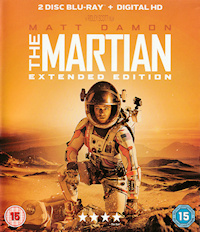
The Martian was first released in early 2016 in its original theatrical cut and a few extras like deleted scenes, but without a lot of bonus material. This caused a bit of a stir because it was widely known that there was a lot more material that could have been made into a director’s cut – and exactly that happened with the release of the Extended Edition that came out in June 2016 in the US and in October in the rest of the world. Of course I couldn’t wait and got the theatrical version on DVD in early 2016, which was a fortunate choice. It was the last movie I was able to watch together with my mother, who unexpectedly passed away in May 2016 after a brief illness. I already had started writing this review back then, but gave it up as life had intervened in the most unfortunate way. Only in late 2019 I ordered the UK Extended Edition Blu-Ray and it was really worth it. The extended cut is only about ten minutes longer than the theatrical version, but adds some crucial scenes important to the plot. The extras made the Blu-Ray worth buying the film again: there’s not only a very entertaining audio commentary with the writers and the director, but also literally hours and hours of bonus materials on a second disc, including a long documentary and much more. It’s a fantastic release, easily worthy of the Criterion label and probably one of the last really amazing special editions that were ever produced. Sadly, the extended edition was never released in Germany, only in English-speaking markets. This one’s for you, Angela, you would have had so much fun watching it all! |
   |
|||
|
The Martian already looked amazing on DVD and looks even more beautiful on this Blu-Ray. Filmed entirely on digital Red cameras in 3D, this Blu-Ray of course “only” contains the 2D version but renders it absolutely perfectly. Since the movie was shot completely digital, there was no film transfer involved. It was originally finished in 2K resolution in 2015, rumoured to be upscaled to 4K for the first UHD releases and later re-released in a native 4K UHD. This Blu-Ray is, of course, based on the original 2K master. Both the extended and theatrical versions have the same great quality, there is actually no difference to be seen on the extended scenes. Despite the fully digital master, the image has a nice film-like appearance and was not electronically further enhanced. Sharpness and detail are excellent and the colours are perfect. The rumour that red does not render well on digital cameras is wholly unfounded here, the artificial Mars looks perfect and not only red, but with many subtle shades of the colour. The only scenes in which the quality notably, but intentionally dips are the Go-Pro-Like recordings of Watney’s logbook. Apparently the year 2035 has not progressed much in terms of small utility cameras but this is really the fun of the movie and makes the rest of the scenery on Mars, on the spaceship and on Earth look stunning in comparison. With the Bonus materials residing on a separate disc, the extended edition can spread over a whole BD-50 and is able to use the space for a very high bitrate that often tops out at about 33 mbit/s. While the streaming versions always looked a bit muddy especially in the space scenes, the Blu-Ray shows how good High-Definition can really look. Although already almost ten years old by now, this Blu-Ray has a fantastic quality that will still look good on really large screens and is a huge improvement over the DVD releases. |
||||
|
The Martian Extended Blu-Ray comes with three main soundtracks. The English original is encoded in DTS-HD Master Audio 7.1 while the Spanish and French tracks are included in “ordinary” Dolby Digital 5.1. I have of course listened mostly to the English track and as usual as a ProLogic Surround downmix, but even this sounds better than the DVD or the Disney+ stream. The wide sound mix makes full use of front and rear soundstages especially through the music but rather than being loud and bombastic, it creates a warm soundscape enveloping the audience. There are not many loud direct sound effects but when they are used they successfully stand out via the rear channels. The dialogue is mostly anchored in the front channel but sounds very realistic and warm with the exception from some of the Mars scenes when the “GoPro”-footage is shown or Watney is talking over helmet audio. Despite those deliberate degradations the dialogue is always completely intelligible and there is rarely any reason to switch on the subtitles. A short listen to the Spanish and French tracks reveals that they sound largely the same as the English original, but with a bit less dynamic and more artificial voices. |
||||
|
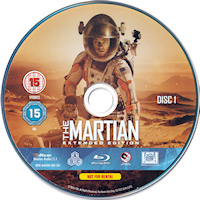
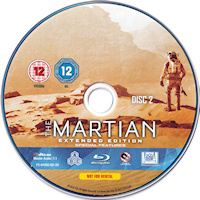
This Blu-Ray not only delivers both the theatrical and extended edition of the movie, but also a whole lot of extras that are packed into a nicely polished menu system. The Audio Commentary with director Ridley Scott, Author Andy Weir and script writer and executive producer is available on both cuts of the film and highly entertaining. While Ridley Scott was recorded separately and has quite a few interesting bits to contribute, he is somewhat prone to just narrating the movie. The bulk of the commentary is fortunately picked up by the two writers, who recorded their commentary in the same room and have a lot of fun recounting their great Mars adventure and how it all came together and the many complicated decisions that had to be made to transform the novel into the book. The audio commentary is subtitled in English, Spanish and French. Disc 2 contains all the additional extras. The Deleted Scenes (4:06) are “Mark Calculated Rover Travel Distance”, “Hermes Crew Discuss Sleeping Arrangements”, “Mark looks at Earth from Hermes with Final VO”, all presented in great HD quality but only with Dolby Digital 2.0 sound. There are no comments from the filmmakers and it’s a bit odd that only a few scenes were included. The Long Way Home: Making The Martian (79:21) is almost a movie in itself and is not just a slapdash Making Of, but a full proper documentary about the movie’s creation. Produced by veteran movie documentary filmer Charles de Lauzirika it brings interviews with the filmmakers, the cast and even scientists together with behind-the-scenes footage in an earnest and unique look into how The Martian was made. Investigating Mars has the “real world” extras that were compiled for the Blu-Ray release. They are basically a time capsule of the NASA that existed in the mid-2000s which was completely different than today. Dare mighty Things: NASA’s Journey to Mars (14:47) is a short but important featurette about the state of the Mars Mission with NASA personnel. The Journey to Mars 101 (122:18) contains three segments from a live panel in front of an audience conducted in Summer 2015. Ridley Scott Discusses NASA’s Journey to Mars (1:31) is a quick snipped of the director making a few short remarks about the Mars Mission. The Gag Reel (7:33) is not just a random bunch of outtakes, but a well-edited collection of bloopers partly set to music that is a lot of fun to watch. The Ares Mission Videos (30:32) are a good half-hour of “fake” promotional material created for the Mars mission. It starts with Neil deGrasse Tyson looking pretty young at 77 in 2035 and continues with a multitude of interviews of the crew and other mission personnel that look better than the material produced by NASA back in 2015. The Production Art Gallery (16:39) is split into the three sections Earth, Hermes and Mars and contains altogether an impressive 200 images ranging from early concept drawings to beautiful finished art. The Theatrical Trailers have the Trailer A (2:55), B (2:55), G (2:27) and R (2:50). Presumably there were other trailers but the ones included are already pretty similar. |
||||
 The Movie