 Jabberwocky |
||||
|
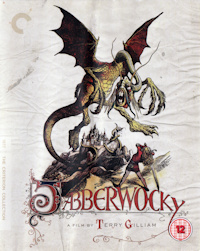
Title | Jabberwocky | ||
| Studio | Umbrella Entertainment (1977) | |||
| Released by | Criterion Collection (2017) | |||
| Disc Type | BD-50 (44.3 GB) | Bitrate | ø 35 max. 40 | |
| Runtime | 106:01 Minutes | Chapter | 14 | |
| Region | 2 (England) | Case | Amaray | |
| Format | HD 1080p24 AVC | |||
| Image | 1.85:1 | 16:9 |  |
|
| Sound |  HD Master  English   Commentary |
|||
| Subtitles | English | |||
| Rating | BBFC 12 | |||
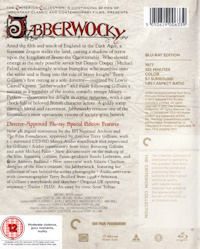
| Extras | • Audio Commentary from 2001 with Director Terry Gilliam and Actor Michael Palin • New Documentary on the Film featuring Gilliam, Palin, producer Sandy Lieberson and actor Annette Badland • New Interview with Valerie Charlton, designer of the Film’s Creature • Audio Interview with Cinematographer Terry Bedford from 1998 • Selectionb of Gilliam’s Storyboards and Sketches • Original UK Opening Sequence • Trailer |
|||
|
In the dark ages, Dennis, the son of a cooper, is disowned by his father on his deathbed and seeks his fortune in the big city, hoping to win the hand of his beloved Griselda. But the city and the kingdom of King Bruno the Questionable are threatened by a terrible monster – and Dennis is soon unwillingly drawn into the rapidly unfolding events… After almost five years of working together, creating 45 television episodes and two feature films together, the British comedy group Monty Python had not really broken up, but the seven members temporarily went their separate ways in the mid-1970s. Terry Gilliam, the group’s only American, was initially just responsible for the quirky cutout animation of The Flying Circus and rarely appeared on screen in person. Only gradually he established himself as an actor, writer, and director over the years. During the production of their first feature film, Monty Python and the Holy Grail, he split the directing duties with Terry Jones and he developed a taste for it. Like his colleagues, Gilliam used Monty Python’s self-imposed hiatus to develop a project of his own. Inspired by the setting of Monty Python and the Holy Grail, Terry Gilliam decided to return to the dark middle ages and this time chose Charles Alverson, an old friend from his pre-Python days, as his writing partner. Gilliam had long been fascinated by Lewis Carroll’s brilliant nonsense poem Jabberwocky from the Alice in Wonderland sequel Through the Looking Glass and had considered making a film out of the tale of the eerie monster. In 1971, the Czech animator Jan Svankmajer had beaten him to it with a fifteen-minute animated adaptation, but that didn’t deter Terry Gilliam from creating a live-action film of the unusual source material. Two years after Monty Python and the Holy Grail, around 1976, the screenplay for Jabberwocky was more or less finished. With the help of some old acquaintances, including impresario and producer Michael White, Terry Gilliam was able to secure financing, primarily from private investors and the National Film Trust. Producer Sanford “Sandy” Lieberson was captivated by Jabberwocky after initially wanting to hire Gilliam as an animator for a bizarre documentary satire called All This and World War II, but then realized the filmmaker was more interested in his own project. The budget was tiny, but still almost twice that of Monty Python and the Holy Grail, giving the fledgling solo director a little more creative freedom. While Holy Grail was more or less a collection of medieval-themed sketches with only a loose overarching plot, Terry Gilliam and Charles Alverson set out to tell a more coherent story this time. The titular monster was merely the starting point for a satirical portrait of the dark ages, hints of which were already visible in Holy Grail. The plot, revolving around the involuntary adventures of a young man who seeks his fortune in a medieval metropolis and becomes entangled in its political and economic machinations, proved to be the ideal stage for Gilliam’s clever ideas. The story was seasoned with a far more cynical and dark humor than previously known from Monty Python, yet still closely related to the wit of The Flying Circus and especially The Holy Grail. Jabberwocky skewered a whole host of clichés of the genre and painted a picture of the middle ages unlike any other movie, but was perhaps the closest to reality. The concept of a crumbling city state with an incompetent and infantile king, merely a pawn of wealthy merchants, was not simple comedy, but rather a clever satirical tale. Terry Gilliam crowned it all with the threat of the Jabberwocky monster, which quickly becomes a political football. Despite the inherent humour, the film’s plot is by no means a lighthearted romp, but a miserable, gray, and dusty affair that vividly illustrates just how filthy it truly was back then. Necessity, stemming from a low budget, was turned into a virtue, and the often minimalist sets create a wonderfully bleak atmosphere. From the beginning, Terry Gilliam had his Python co-star and writer Michael Palin in mind for the lead role, believing him best suited to portray the naive young man. But first the director had to prevail against his producer, who wanted to cast the then much better known Michael Crawford instead of Palin. Ultimately Gilliam was able to insist on Palin, who, in addition to his versatile appearances in the Flying Circus and as Sir Galahad in Holy Grail, also played one of the main roles in a successful 1975 TV adaptation of Jerome K. Jerome’s Three Men In A Boat. Together with fellow Python Terry Jones, he had also created the adventure parody series Ripping Yarns for the BBC as both writer and performer. For Michael Palin, it was his first major leading role in a movie, but apart from a small cameo by Terry Jones at the beginning and a brief appearance of his own, Terry Gilliam otherwise refrained from casting other Monty Python members. For a film with a minimal budget, Jabberwocky boasted a surprisingly large and diverse cast, featuring many big and small names from the British film and television industry. For the role of King Bruno the Questionable, Terry Gilliam secured a legend: Max Wall, the son of a music hall entertainer, who had, after an early career on the British variety stages in the late 1940s, also made the leap to serious theater, television, and even the big screen. His ageing King Bruno was not just pure slapstick, but also possessed a tragic and cynical element that perfectly complemented the film’s melancholic atmosphere. Alongside the King as his Chamberlain was another acting legend, John Le Mesurier, best known for his role in the long-running British sitcom Dad’s Army. Together they provide an amazing duo that is not only just slapstick, but a special kind of old-time comedy. Harry H. Corbett, one half of Steptoe and Son, played a wonderfully over-the-top squire in one of the larger roles, whom Dennis encounters during his adventures in the city. The busy stage and television actor Paul Curran appeared as Dennis’s father, but the role of Mr. Fishfinger, the father of Dennis’s love interest, went to Warren Mitchell, who had starred for ten years in Johnny Speight’s sitcom Till Death Do Us Part – the British model for Wolfgang Menge’s German classic Ein Herz und eine Seele. The few female characters were also cast with Gilliam’s usual precision. The busy theatre and television actress Annette Badland plays Griselda, Dennis’s larger-than-life dream woman in her short appearance wonderfully vulgar and funny while another television legend, Brenda Cowling, joined the cast in a small role as Mrs. Fishfinger. The casting of the princess is often mistaken for Shelley Duvall, but it is actually the relatively unknown actress Deborah Fallender who plays her small role here with great enthusiasm. Filming took place primarily at Shepperton Studios, where Terry Gilliam was allowed to use the sets from the 1968 musical Oliver!, which were still standing almost ten years later. While Gilliam was busy in Shepperton in 1976, a little production called Star Wars was filming on the nearby stages, much to the amusement to both of the directors who never really crossed paths while some of their crews worked on both productions. Some exterior shots were also filmed on the Shepperton grounds, but Gilliam found suitable castles and fortresses only in Wales, where the remainder of the filming took place at several locations. Gilliam, along with Production Designers Roy Forge Smith and Milly Burns, based the film’s design partly on the richly detailed paintings of Pieter Bruegel the Elder, which were then remarkably effectively brought to life by Holy Grail cinematographer Terry Bedford. For the authentically gritty costumes, the director relied mainly on Hazel Pethig, the Flying Circus costume designer, and, of course, entrusted the makeup and hairstyling to his wife, Maggie Weston. Some rudimentary special effects were also needed to bring the medieval world to life; these were filmed by John F. Brown, who later worked for ILM. The biggest challenge, however, was the titular monster, designed and built by Valerie Charlton and Clinton Cavers based on Terry Gilliam’s designs. Like everything else in Jabberwocky, the monster was an almost pitiable, half-dead, moth-eaten creature, not an elegant dragon or dinosaur. It was a horror cliché taken to the extreme in typical Gilliam fashion, just like the way the monster devours its victims. Hammer Studios would have been proud. There was not enough money left for an elaborate musical score, but just as with Holy Grail, Terry Gilliam once again very effectively drew on the legendary De Wolfe music archive. He selected exclusively classical music by Mussorgsky, Rimsky-Korsakov, and Ravel, whose dark mood created exactly the right atmosphere for the film and, above all, was inexpensive. In contrast, the sound design was surprisingly elaborate, although it had to be limited to a mono mix for budgetary reasons and couldn’t utilize the newly introduced Dolby Stereo yet. Nevertheless, it was wonderfully detailed and generated many gags with its sound effects. As the first solo film by Terry Gilliam, who would later become Hollywood’s enfant terrible, Jabberwocky certainly didn’t have it easy. In England, Jabberwocky was distributed by the Columbia-Warner partnership, which existed only briefly in the 1970s. Adhering to the director’s stipulations not to associate him or the film with Monty Python, the film still attracted audiences who expected typical Python humor and were less than enthusiastic about the dark medieval satire. In the US, distributor Cinema 5 caused a scandal by releasing the film under the title Monty Python’s Jabberwocky, incurring both the wrath and legal action of Terry Gilliam. The film’s success in the US was also limited, and before the end of 1977, a dubbed version of Jabberwocky was shown in German cinemas. Even there, the completely different style proved largely uninteresting. Nevertheless, a surprising effect emerged during its marketing in other countries: wherever Monty Python was less known, Jabberwocky became a success, while Python aficionados dismissed Terry Gilliam’s first solo film as boring, over-the-top, and unfunny. The parallels between Jabberwocky and Monty Python are actually undeniable, and the similarities to Holy Grail are particularly striking – both films, upon closer inspection, seem like twins filmed together, although Jabberwocky focuses more on its plot and less on sketch comedy, possessing an even darker sense of humor. Almost half a century after its creation, Jabberwocky has not really become a masterpiece, but it has developed into a hidden gem in the filmographies of Terry Gilliam, lead actor Michael Palin, and even Monty Python himself. No history of the British comedy troupe would be complete without mentioning Jabberwocky, which brought Terry Gilliam’s incomparable style to the big screen for the first time and even heavily influenced later Monty Python movies. It also led to Terry Gilliam’s next movie Time Bandits, another collaboration with his friend Michael Palin that turned out to be a fun romp through time and many different genres – and Gilliam’s most successful movie.
Jabberwocky was first released on DVD in 2001 in the US and in 2002 in Europe alongside the special edition of Monty Python and the Holy Grail, but the studio hadn’t put much effort into Terry Gilliam’s first feature film. Even for 2001, the transfer was subpar, but at least Terry Gilliam and Michael Palin recorded an entertaining commentary track. For its 40th anniversary in 2017, the British Film Institute was finally able to secure funding for a new restoration based on the camera negative. This restoration was first released by Criterion on Blu-Ray and DVD in the US and in the UK and in 2021 by Capelight in Germany, with almost all the extras from the Criterion. Sadly I missed out on the German Blu-Ray which ran out of print quickly, but I was able to get my hands on the British edition of the Criterion Blu-Ray, which is reviewed in this article. The German Blu-Ray is basically identical with the Criterion release but hard to get, although the Capelight DVD is still available but lacks the second part of the documentary and the sketch-to-film comparison. |
  |
|||
|
Jabberwocky was made on a similarly low budget to Monty Python and the Holy Grail and was never a particularly good-looking film, so with the transfer technology from 25 years ago it didn’t look very good even back then. Fortunately the new 4K restoration made by the British Film Institute fixes almost all of the problems and makes Jabberwocky look astonishingly good. This restoration is nothing short of astonishing. Basically all the flaws of the extremely rough 2001 transfer have been fixed without making the movie look to digital – if at all, Jabberwocky now looks even more grim and brooding without all the distracting scratches, dust and shaky image of the old version. The new transfer has been cleaned extremely well and has none of the copious debris from the old version. At the same time the texture of the film has been marvellously preserved because all the grain is still there but now looks much more natural. The image has also been stabilized very well and all the fluttering, swimming and waving is gone. The new colour restoration is also a huge improvement that makes the film look much better, if radically different. The former brown-green mess that sometimes fluctuated from scene to scene and the wildly inappropriate brightness and contrast have been reigned in. This means that the movie now has an overall darker look, but it is noticeably more colourful and looks much more lifelike than the artificially boosted brightness that killed the black levels before. Sharpness is not spectacular due to the limits of the source material, but in most scenes is pretty good considering the circumstances. No artificial sharpening seems to have been used and so a few scenes look a bit less detailed than others. It’s still a very grainy movie, but now looks much more natural and completely like a film projection. The authoring of the Blu-Ray is absolutely unobtrusive and used a relatively high bitrate that does not turn the grain into mush. |
||||
|
Together with the new restoration the BFI had also made a new 5.1 mix in 2017 that is similar, but not identical to the track from the previous transfer. It’s basically a slightly enhanced Mono track that has even less of the stereoization of the 2001 version but is so close to the original sound mix that the absence of a Mono track is not a problem. The newly restored soundtrack – encoded in DTS HD Master Audio 5.1 on the Blu-Ray – undoes a few of the overzealous sound effects from the previous 5.1 sound mix but most importantly sounds like it comes from a much better source. While the old version was somewhat brittle especially in the voice department and seemed to come from an optical track, the BFI must have sourced this version from the original magnetic tracks that were unearthed together with the original camera negative. Treble, bass and dynamic have been noticeably improved and especially the dialogue now sounds a lot less scratchy and thin. Even the stock music sounds a little better. The surround upmix is now less pronounced but still uses all channels occasionally for light environment noises, crowd cheering and of course the “action” sequences like the tournament and the monster attacks. The voices are still anchored in the center channel but get an occasional roomy sound too. This is a much more careful upmix that matches the age of the movie and sounds much more like an early surround mix of the late 1970s. There are only English subtitles on the British Blu-Ray. |
||||
|
The original DVD of Jabberwocky did have a few extras but the new release from Criterion adds quite a bit more in the handsome, slightly animated menus. The Audio Commentary with Terry Gilliam and Michael Palin was originally recorded for the 2001 Columbia release and still ives up to expectations. Terry Gilliam has always proven himself as an excellent storyteller on his previous commentary tracks and with his friend and collaborator Michael Palin at his side, the conversation between the two Pythons becomes even more engaging. They take a rather candid look at their “youthful indiscretion” but they appreciate their work and that of the other contributors, offering only constructive criticism of their movie. A good deal of humor is woven into their reminiscences and anecdotes, making this commentary track both enormously interesting and entertaining. “Jabberwocky”: Good Nonsense (40:49) with Terry Gilliam, Michael Palin, Annette Badland and Sandy Lieberson was produced for the Criterion release in 2017 and is a wonderful documentary about the creation of the movie with the filmmaker, the two actors and the producer. It builds upon the many stories told by Gilliam and Palin on the audio commentary by further including the very funny and enthusiastic Annette Badland and producer Sandy Lieberson. Valerie Charlton: The Making of Monster (14:49) is a short, but wonderful little interview with the special effects artist who recounts her work on the film. This is basically another chapter of the first documentary, bringing the runtime up to nearly an hour. The Interview with Terry Bedford (22:29) is audio-only and was conducted over the telephone by writer David Morgan in 1998. It may have a really bad quality, but makes it up with interesting insights by the cinematographer of working with Terry Gilliam on not only Jabberwocky but also Monty Python and the Holy Grail. The Original Opening (3:16) is actually the early UK version of the beginning of the movie, which Terry Gilliam later slightly modified for the US release. The introduction also explains that the director prefers his revised opening together with the uncut UK version of his movie. The original is presented in HD but in a rough 1.37:1 transfer without restoration. The Sketch-To-Screen-Comparison (7:00) was one of the few extras on the 2001 DVD and shows a selection of scenes together with Terry Gilliam’s drawings. The Trailer (1:27) bears Terry Gilliam’s unmistakable signature and is a satire in itself. It has been re-transfered in high definition for the Blu-Ray. Lewis Carroll’s “Jabberwocky” (1:27) is a lovely rendition of the source material read by Michael Palin and Annette Badland. |
||||


 The Movie