 It Came From Outer Space |
||||
|
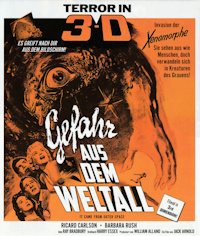
Title | It Came From Outer Space (Gefahr aus dem Weltall) | ||
| Studio | Universal (1953) | |||
| Released by | Koch Media (2017) | |||
| Disc Type | BD-50 (45.3 GB) | Bitrate | ø 35 max. 40 | |
| Runtime | 80:05 Minutes | Chapter | 8 | |
| Region | B (Germany) | Case | Elite | |
| Format | HD 1080p24 AVC | |||
| Image | 1.37:1 | 16:9 |  |
|
| Sound |  HD-Master  English  German, Commentary |
|||
| Subtitles | English, German | |||
| Rating | FSK 12 | |||
| Extras | • Audio Commentary by Film Historian Tom Weaver • Teaser • Trailer in 2D und 3D und anaglyper 3D-Version • Interview mit Regisseur Jack Arnold • Dokumentation “Das Universum laut Universal) • Super 8 Fasung in anaglypem 3D • Bildergalerie mit seltenem Werbematerial |
|||
|
Amateur astronomer John Putnam (Richard Carlson) and his fiancée Ellen (Barbara Rush) witness a meteor crash into Earth in a massive fireball. A curious scientist, John investigates the crash site near an old mine and discovers not a meteor, but an artificial object, which is immediately obscured by a landslide. No one in the small desert town of Desert Rock believes John’s account – until more and more people in the town suddenly disappear and reappear strangely transformed… The 1950s were a veritable playground for science fiction films of all kinds, but extraterrestrial visitors and space travel were particularly popular due to the ever-increasing UFO hysteria. Every major and minor film studio rode the wave, resulting in countless movies, but only a few stood out positively from the crowd. With few exceptions, the films revolved around relatively peaceful extraterrestrial visitors, but truly intelligent science fiction was rare. A notable example was Robert Wise’s The Day the Earth Stood Still from 1951, but the more contemplative style was soon superseded by the destructive alien image in George Pal’s 1953 adaptation of H.G. Wells’ War of the Worlds. universal, the studio that had made a name for itself since the 1930s with its many horror films featuring various Draculas, Frankensteins and others, didn’t enter the science fiction genre with a flashy action spectacle, but rather with a comparatively sophisticated film. Universal was particularly keen on two things: finally making a proper entry into the science fiction market and utilizing the then-popular 3D film technology. William Allen, the producer in charge at Universal, had the idea of combining these two opportunities to make a film about an alien crash landing. Allen had Ray Bradbury in mind as the screenwriter, who was known for his science fiction novels such as Fahrenheit 451 and The Martian Chronicles, but had no prior screenwriting experience. Bradbury was commissioned to write a short treatment, which he submitted under the title The Meteor. Universal, however, had no intention of letting Bradbury write the entire screenplay, even though the eager young author wrote at least four different longer treatments to give the studio a choice between benign and hostile aliens. The studio paid him a meager $3000 and fired him without comment, only to hand the treatments over to screenwriter Harry Essex. What then happened has been the subject of several disputes. While Essex claimed that he wrote the majority of the script, producer Willam Allen revealed later that Essex was strictly instructed to only add technical details. Nevertheless, he was credited as the sole screenwriter in the end credits alongside the “story writer” Ray Bradbury. Years later, Bradbury published all of his four treatments in a book. Jack Arnold was originally a Broadway actor and, after World War II, turned to making documentary short films for the US government and private companies. Since 1952, Arnold had been under contract with Universal as a freelance director and had only made one film before landing the studio’s first science fiction project, titled It Came From Outer Space – more by chance than by personal initiative. Everyone involved was venturing into completely uncharted territory: neither the studio nor producer William Allen had the slightest clue about science fiction or the 3D process. The studio gave Arnold complete creative freedom as director, as long as he stayed within the rather generous budget of approximately $800,000. It Came from Outer Space was primarily a technical challenge, as very few films had been shot using the new 3D technology. But Jack Arnold was careful not to be overly distracted by the technology and placed great importance on making the story a gripping thriller, not a mindless action movie – the source material simply wasn’t suited for that. A certain amount of well-calculated special effects and specially arranged 3D sequences were, of course, mandated by the studio, but otherwise, Jack Arnold had considerable creative freedom and made full use of it. Despite the focus on effects and aliens, the film did feature a cast of quite respectable actors. The relatively unknown Richard Carlson was chosen for the lead role of the scientifically minded, rational amateur astronomer John Putnam. Carlson, who had played numerous small and large roles in countless films since the late 1930s following a theater career, never achieved true fame as a stock actor at Universal. Carlson likely landed the lead part in It Came From Outer Space primarily because he was more often associated with B-movies at the time. Richard Carlson delivered a very strong performance, skillfully avoiding the most typical cringe-worthy moments – in fact, he plays the charming, attractive scientist quite convincingly. His co-star, Barbara Rush, fifteen years younger than the 41-year-old Carlson, had also recently signed with Universal and had even appeared in Paramount’s War of the Worlds. She had already gained some science fiction experience in 1951s When Worlds Collide. In It Came From Outer Space, she sadly doesn’t have much more to do than look pretty and scream heartily from time to time – she’s not a bad actress at all, but the script simply doesn’t give her much to do. The supporting roles are unspectacular but effectively cast. Charles Drake plays Sheriff Warren not as a doddering old man, but as a relatively young, modern lawman who can hold his own quite well, even against his friend John Putnam if necessary. The rugged Joe Sawyer and the younger Russell Johnson, both more famous than the two leads at the time, play the two telegraph technicians who are among the first abduction victims and portray their transformation from easygoing desert workers to stiff aliens superbly. The technical execution was handled by Universal’s long-time Special Photography expert, David S. Horsley, who put so much work into the film that the project was sometimes called “Horsley’s Experiment.” Clifford Stine, the film’s cinematographer, was actually a special effects specialist too and was apparently hired for It Came From Outer Space to ensure that filming in the new 3D process wouldn’t turn into a disaster. In fact, the 3D effects were only used prominently in a handful of scenes and were otherwise limited to more conventional scenery. The effects were never used as obtrusively as in Warner’s 3D spectacle House of Wax, released two and a half months before Jack Arnold’s movie. The musical score was somewhat inspired by Bernard Herrmann’s score for The Day the Earth Stood Still , which was the first to use the famous theremin sound in a science fiction film. for It Came From Outer Space wasn’t written by a well-known composer, but by the young Henry Mancini, Irving Gertz, and Herman Stein, who shared the work on the mere 36-minute score but received no credit. That credit went solely to the “musical director,” Joseph Gershenson, who hadn’t composed a single note of the music himself. The score is actually one of the better compositions from the 1950s science fiction wave and, although it doesn’t offer a great deal of melodic variety, it contributes a lot to the eerie atmosphere of the film. The desert scenery, filmed primarily in the Mojave Desert in California and in areas near Universal Studios, later became Jack Arnold’s trademark. A large portion of the desert scenes were actually filmed on elaborate studio sets to better control the 3D effects. In the finished film, it’s almost impossible to distinguish which scenes were filmed in the studio and which on location, because even the desert scenes have a certain studio-like artificiality. In any case, Jack Arnold succeeded in creating an impressively eerie and mysterious atmosphere from the desert. At the beginning of filming, it wasn’t even clear how the aliens would appear in their true form in the film. The script, even in the version revised by Harry Essex, originally stipulated that the aliens would only be shown briefly at the very end of the film – and that’s exactly how the corresponding scenes were initially filmed. But then Universal’s management decided that the film absolutely had to feature a real monster. Two different designs were created, fully built, and test shots were filmed after which Universal executives selected one monster. Because filming had already wrapped, some key scenes had to be reshot with the alien monsters. Neither producer William Alland, nor writer Ray Bradbury, nor director Jack Arnold were enthusiastic about the idea of ??actually showing the “monster” and would have preferred to leave the aliens’ appearance to the audience’s imagination – but the studio bosses insisted, fearing they wouldn’t be able to market the film otherwise. This was the only concession Jack Arnold had to make to Universal for It Came From Outer Space, one he was very disappointed with but ultimately had to accept. From today’s perspective, it is indeed these scenes that give the film a somewhat bitter aftertaste, but only because the alien design has been copied and imitated so often. Unfortunately, the rubbery-looking aliens have unfairly given the film the reputation of being a silly B-movie to this day, even though that’s not the case at all. While the story itself isn’t particularly sophisticated, Jack Arnold’s approach to the subject is surprisingly complex compared to other science fiction spectacles of the 1950s. The film’s plot is less science fiction than a solid thriller with elements of horror. Most noteworthy is the underlying theme that aliens don’t necessarily have malevolent intentions – not explored in quite the same moralistic way as in The Day the Earth Stood Still, but on a much more human level. The aliens crash-land on Earth, knowing that their appearance alone will immediately lead to their attack. Instead, they seek help by abducting humans in a relatively peaceful manner and replacing them with doppelgangers – a theme that was revisited shortly afterwards in a far more sensational way in Invasion of the Bodysnatchers. In It Came From Outer Space, the aliens don’t intend to harm humanity, but resort to abduction because they’re convinced they can’t expect cooperation otherwise. The film is surprisingly peaceful, because despite all the shock effects and the hysterical outbursts of “scream queen” Barbara Rush, the plot is remarkably non-violent and manages to keep the audience on the edge of their seats with the aliens’ cat-and-mouse game alone. The film doesn’t waste a single minute of its relatively short runtime, and with its precise dialogue and tightly paced plot, boredom never even has a chance to set in. It Came From Outer Space was unleashed in the middle of the short-lived 3D movie craze in June 1953 and despite strong competition managed to turn a solid profit, much to the delight of Jack Arnold and Universal. Audiences loved the science fiction theme and even critics recognized that It Came From Outer Space was not just another run-of-the-mill b-movie but despite the low budget a more sophisticated production. Despite its minor flaws due to the added monster scenes, It Came From Outer Space remains one of the few science fiction films from the 1950s that straddles the line between B-movie trash and a true classic, never quite tipping over completely in either direction. Jack Arnold’s brilliant direction showcased the imaginative style that he would further perfect in his later films. While It Came From Outer Space was primarily famous as a 3D spectacle in its time, it also works remarkably well as a standard 2D black and white film, losing little of its captivating impact.
It Came From Outer Space was originally slated for a DVD release in the US around 2000, when Universal first released its classic horror movies on DVD. After an audio commentary and a documentary were completed, the DVD was inexplicably shelved, only to be released two years later. While the DVD did include the audio commentary and documentary as extras, it featured a poorly restored transfer, as if Universal had run out of budget for the horror DVD series. Fortunately, in 2016 a new Blu-Ray with a restored transfer in both 2D and 3D was released – first in the US by Universal and then by Koch Media in Germany. The German disc has all the extras from the previous DVD and the US Blu-Ray with the addition of a rare German TV interview with Jack Arnold and some other goodies that makes it the best edition worldwide. |
  |
|||
|
The German Blu-Ray has a brand new HD transfer that was restored by Universal in 2016 in both 2D and 3D that improves the disappointing DVD a lot – but it still stops short of perfection. While there is a 3D version encoded on this disc, it’s only playable on 3D capable players and TVs. I had a chance to look at the 3D version converted to an anaglyph via a software player and it does look basically the same quality-wise as the 2D version, but will work better with a proper 3D player and TV. Like the DVD, the Blu-Ray shows the movie in the 1.37:1 aspect ratio without a widescreen option. This apparently shows the entire exposed film negative, but it’s not entirely clear for which format the image was actually composed. According to Tom Weaver’s audio commentary, the movie was shot in 1.85:1 for a widescreen presentation, he even mentions that the screens of the two premiere theaters had to be widened. However, apart from the opening and closing credits, the image composition actually looks much more like 1.37:1 and would lose too much space at the top and bottom in matted 1.85:1 format. Showing it in 1.37:1 makes much more sense and is the correct decision. The new transfer makes the best out of the difficult source material and looks much cleaner than the old DVD. Brightness flickering is still the most obvious flaw in some scenes and while there are still a few remnants of scratches and white dropouts, they are much less noticeable than before. Film grain is much more present too, probably due to the higher resolution, but it looks very The sharpness is quite good for a movie from 1953, but fluctuates a little bit sometimes due to the source material especially during the special effects. Overall the image is so detailed that the transfer almost reaches the limits of the film material. The image is also much more stable. Brightness and contrast also have been better balanced, showing a wide range of grayscale tones. Even the previously flat contrast in the day-for-night scenes now don’t seem to swallow the shadows too much anymore. The compression is absolutely invisible with an above average bitrate. While the new transfer isn’t completely perfect due to flaws in the source material, it’s the best the movie has ever looked. |
||||
|
The audio of It Came From Outer Space was already far superior to the picture quality on the old DVD and has only been improved for the Blu-Ray. Anyone expecting an old, noisy, and crackly mono track will be pleasantly surprised. While the German dub is only available in mono, the original English stereo mix is ??presented in astonishing quality. The original English version was mixed in three-channel discrete stereo for its 1953 3D premiere, with the three audio channels positioned behind the screen. The Blu-Ray replicates this sound as a discrete DTS-HD Master 3.0 track that still sounds great as a 2.0 downmix played through a ProLogic decoder. For a truly faithful reproduction, you would have to disable the surround channel decoding, but by chance, the soundtrack was mixed in such a way that some of the music and a few sound effects also end up on the rear speakers. This isn’t true surround sound, of course, but the soundtrack on the Blu-Ray, played back in Pro Logic, sounds surprisingly spacious without any unpleasant distortion. The stereo separation of the soundtrack is very playful – in addition to the rather wide-ranging music, the sound effects are scattered across the entire soundstage, and even the dialogue isn’t confined to the center. The sound quality is surprisingly good for a fifty-year-old film, but it does have its limitations. Frequency range and dynamics are relatively good for the music; it lacks a bit of treble, while the bass is decent. The sound effects sometimes pack a real punch, but otherwise sound somewhat tinny. The dialogue also sounds surprisingly full and powerful, even though it appears to have been mostly recorded live on set and not dubbed in a sound studio. The German version, apparently still sourced from an optical mono track, naturally can’t compete with the sound of the original English version, but it doesn’t sound as bad as other poorly restored German dubs of this age. While the dynamic range is considerably worse than the English version, the difference in frequency response isn’t as noticeable. Overall, the German version also has a relatively clean sound – the voices, in particular, are completely undistorted – but there is a very high level of background noise and rumble. Subtitles are provided in both English and German. |
||||
|
The Blu-Ray carries over all the extras from the already well-stocked DVD, but also adds a few noteworthy new featured that are available only on the German disc. The menus are static and only available in German, but look appropriately vintage. The Audio Commentary by horror film historian Tom Weaver is among the very best of its kind and incredibly informative. Perfectly prepared, Weaver talks almost nonstop throughout the entire film, not only about its creation but also reading from the treatments, the screenplay, film reviews, and biographies of those involved, covering virtually every conceivable aspect. Although his rapid-fire delivery makes him seem somewhat academic, Tom Weaver manages to be very entertaining and sometimes even funny. What the documentary lacks, the commentary track more than makes up for with its sheer volume of information. The track is subtitled in both English and German. The Universe According to Universal (31:36) by David J. Skal, with commentary by Rudy Behmler, was produced in the spring of 2000, as was the commentary track. It isn’t actually a documentary about It Came From Outer Space alone, but rather, as the title describes, about Universal’s science fiction films in general. Science fiction historian Vincent DiFate, collector Bob Burns, “Monstrous Movie Music” producer David Schecter, film historian Paul M. Jensen, 3D film archivist Bob Furmanek, and, the only person directly involved in the production of It Came From Outer Space , composer Irving Gertz, all appear in far too brief and not particularly insightful interviews. While the making of It Came From Outer Space is discussed in more or less detail in the first half of the film, the mention of the other films, garnished with extensive film clips, feels more like an extended promotional video. This featurette can’t really be called a serious film documentary – it’s more of a retrospective of Universal’s old science fiction films. Jack Arnold Erzählt (13:36) is a rare excerpt from a series of interviews with the director from 1983 made for a series of German television broadcasts of his movies. The short, but precise interview lets Jack Arnold recount the making of It Came From Outer Space with some interesting details. It’s available with and without the German voiceover. Anaglyphe 3D Super 8 Fassung (15:50) is exactly what is says – a transfer of a red/green anaglyph 8mm 3D cut of the movie in, of course, fairly terrible quality and unfortunately, also only with a German soundtrack but with English credits. Deutscher Super 8 Anfang (1:13) & Deutsche Super 8 End Credits (1:05) are the beginning and ending of a German 8mm print of the movie, although not in 3D. The Trailer (2:41) is available in both 2D and 3D versions. A third, slightly different Anaglyph Trailer (2:32) is also available in a red/cyan print in lesser quality. There is also a shorter Teaser (1:19) that was the only one included on the old DVD. All trailers are in English only. The Image Gallery (8:43) is different than on the old DVD, but more extensive because a section with German press photos and material has been added. Many posters, drawings and production photos are shown and while it is presented as a video and not a gallery, it’s a very nice collection. |
||||


 The Movie
 Image