 Forbidden Planet |
||||
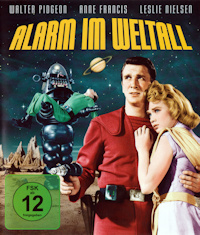
|
Title | Forbidden Planet | ||
| Studio | MGM (1956) | |||
| Released by | Warner Home Video (2010) | |||
| Disc Type | BD-50 (30.5 GB) | Bitrate | ø 20 max. 25 | |
| Runtime | 107:36 Minutes | Chapter | 24 | |
| Region | ABC (Germany) | Case | Elite | |
| Format | HD 1080p24 AVC | |||
| Image | 2.40:1 | 16:9 |  |
|
| Sound |  HD-Master  English  German, French, Spanish, Portugese |
|||
| Subtitles | English, German, French, Spanish, Portugese | |||
| Rating | FSK 12 | |||
| Extras | • Unused Scenes • Watch the Skies! Science-Fiction, the 1950er and Us • Amazing! Explore the Far Reaches of Forbidden Planet • Robby the Robot: Engineering an Science-Fiction Icon • MGM Parade – Excerpts from two Episoides • Complete 1957 movie “The Invisible Boy” • TV-Episode from 1958 “Robot Client” from The Thin Man • Trailers |
|||
|
In the 23rd century interstellar travel has become reality. Commander Adams and his crew are tasked to travel with their C-57D spaceship to the far away planet Altair to find out what happened to an expedition that was sent out twenty years before. They encounter Dr. Morbius, one of the crew members, who at first is very reluctant to let them land on the barren planet where he and his daughter are the only survivors of the expedition… At the beginning of the 1950s, sophisticated science fiction movies about alien life and travel in space and to other planets were far and few between. There were rare exceptions like The Day the Earth Stood Still or Destination Moon who treated the genre seriously, but the majority were quickly and cheaply produced horror shockers with a space theme, of which Jack Arnold’s It Came from Outer Space and William Cameron Menzie’s Invaders from Mars had been some of the better examples. Science fiction like it is known today in the shape of Star Wars, Star Trek or other space operas was still largely unknown – until two authors, Allen Adler and Irving Block, tried to get the movie studios interested into a completely new and untried idea. Adler and Block had been working on a treatment with the title Fatal Planet since 1952, but they were unable to sell it to the major Hollywood studios because the authors refused to make a cheap and quick production out of their relatively serious and earnest story. Only Metro-Goldwyn-Mayer, one of the biggest film studio giants of the 1950s, had not yet joined the steadily growing wave of science fiction, but they were searching for an interesting concept. The studio finally found it in Adler’s and Block’s treatment and much to the delight of the authors, the studio was not interested in making a quick buck with their story. Instead they were promised a big and lavish production in the same manner as MGM’s famous musicals. The story the authors had worked on was not just any science fiction tale, but loosely based on William Shakespeare’s The Tempest. The plot was set in far outer space on an alien planet and the characters were condensed and modernized, but the similarities were striking. While Allen Adler and Irving block supplied the original concept, they had no experience as script writers themselves and consented to give their idea to MGM’s long time author Cyril Hume, who carefully fleshed out their treatment. The studio was very conscious about making the now re-titled Forbidden Planet something much better than what the competition had to offer and raise the bar considerably in the science fiction movie genre. The story included elements which were completely new for the mid-1950s audience. So far science fiction mostly consistet of more or less evil aliens visiting the Earth in their flying saucers, often bringing fear and terror, but now Earthlings themselves were the ones making expeditions to alien planets. This relatively new concept, which before had only appeared in science fiction literature and had rarely made the jump into movies, became a big sensation and even resulted in a kind of revolution that had far-reaching implications for the film and television industry. Forbidden Planet was headed by producer Nicholas Nayfack and director Fred McLeod Wilcox, an experienced and seasoned filmmaker, who had been working for MGM since the 1930s. The director had not been much in contact with the science fiction genre before and had also never worked in the Cinemascope widescreen format, making the production challenging. Wilcox and his cinematographer George J. Folsey, another industry veteran, did not take too many risks with the camerawork and shot the movie carefully and almost like a theater production. It would have been the biggest handicap if there wouldn’t have been the sensational visual effects and the strong acting. MGM pulled out all the stops for the casting of Forbidden Planet and brought out some of its biggest stars, headed by studio veteran Walter Pidgeon. One of the great character actors of his time, Pidgeon plays the mysterious Dr. Morbius as a benevolent grandfather figure with a dark side and takes the role entirely serious, giving the movie the much needed straight undertone. While the actor was at this point of his already decades-spanning career not adverse to doing comedy, he treated his character completely earnestly, making Morbius surprisingly realistic. Some of his dialogue, especially the science-fiction-heavy monologues, would have been too much for any other actor of the time, but Pidgeon wholly embodies his Dr. Morbius, making him the strong central point that Forbidden Planet needs. For the role of Morbius’ daughter Altair the filmmakers were looking for the cliche of an innocent, young, blonde beauty and a couple of years before would probably have chosen the young Marilyn Monroe – but the actress had meanwhile established herself as the greatest sex symbol of the 1950s and was also under contract at 20th Century Fox. Instead, the role went to the 25-year-old Anne Francis, who had already been in front of television and film cameras for a decade and proved to have exactly the right charisma for the young and naive Altair. On first glance, she looks like an entirely superficial character, but like her co-star Walter Pidgeon, Anne Francis tool her role serious enough not to make it embarrassing or laughable. The dashing spacehip commander John J. Adams was played by a young actor called Leslie Nielsen in only his second film role after many theatre and television appearances. The handsome, serious leading actor was the same who decades later switched from drama to comedy, becoming one of the most beloved comedians of the 1980s and 1990s – but in Forbidden Planet there was nothing of that noticeable yet. As a fair and intelligent, yet sometimes reckless and adventurous commander he was a prototype of many spaceship captains, most of all, of course, Captain Kirk of the Enterprise almost exactly a decade later. Leslie Nielsen’s no-nonsense approach gave Forbidden Planet a lot of authenticity, emphasizing the militaristic command structure on his spaceship without neglecting the human factor – Adams is not a dictator, but a nice guy who knows how to handle his crew, even though he might be sometimes out of depth with Morbius and his alluring daughter. The somewhat wildwest character of the Bellerophon’s crew is further underlined by some of the supporting cast: there’s of course a ship’s doctor – played unspectacularly, but solid by Warren Stevens – who is at the same time the best buddy of the Captain, something which would continue to be a staple of later science fiction. The other crew is somewhat forgettable and blends into a background of grey uniforms – with the exception of one comedic diversion in the shape of the ship’s cook, played to the hilt by Earl Holliman in one of his earliest film roles. The unnamed character’s main concern is finding genuine earth firewater, getting help from a surprising source. He doesn’t really have any function in the plot and seems to have been shoehorned into the script to create some comedic diversion, but Holliman’s appearance is actually fun to watch in an otherwise very serious movie. Forbidden Planet’s actual star was a special effect – Robby, the robot, constructed by Japanese-American production designer Robert Kinoshita and built with the help of an astronomical budget. He was not just a model, but the first life-size robot in film history properly interacting with people in front of the camera. With his numerous technical gadgets and gimmicks on display, Robby was the ultimate embodiment of science fiction, although he was not even remote controlled. The seven-foot robot creation was moved from within by the uncredited stuntman Frankie Carpenter and briefly by his predecessor Frankie Darrow, who infamously got fired from the production for being drunk and almost damaging the expensive robot. Robby was, of course, mainly meant as a technical gimmick to enhance the science-fiction aspect of the movie, but he also was something of a humorous element. With the unmistakable voice of Marvin Miller, dubbed in during post-production, Robby had the mannerisms of an English Butler, creating a lot of opportunities for comedic diversions, which the script actually manages not to overuse. Robby was also the reason that a version of the Three Laws of Robotics, first formulated by Isaac Asimov in the 1940s in one of his early short stories, make their first film appearance in Forbidden Planet. They are discussed at length in one of the film’s scenes, bringing the audience up to speed on Robby’s safeguards. The iconic movie poster may portray him as a kind of monster – the depicted scene of him carrying what seems to be Altair doesn’t exist in the movie – but in the story he is no menace but a benign and useful machine that actually saves the day in the end. Robby was at least as expensive as his fellow flesh-and-blood actors, if not more – his enormous construction and operating costs made it necessary for MGM to use him in more movies and television series, but he never had such a classy appearance as in Forbidden Planet. Only one year after his debut he returned in the quickly shot B-movie The Invisible Boy, but the plot had absolutely nothing to do with the predecessor and was quickly forgotten, only decades later to surface as a curiosity again. Robby’s further appearances were more of a novelty nature – he was a guest on several television series and he never completely vanished, but his one great legacy was his fantastic part in Forbidden Planet. Today the original Robby is in the hands of a collector, but he was replicated several times and is still one of the great non-human stars of science fiction. Forbidden Planet also paved completely new ways for special and visual effects. Of course it was not first movie making extensive use of effects by far, but one of the first doing so on a really big scale. The ambitious undertaking was headed by A. Arnold Gillespie, the long-time head of MGM’s effects department, who had worked on movies as early as the 1925 incarnation of Ben-Hur. He and his team created the most astonishing special effects of its time which only would be surpassed more than a decade later with Stanley Kubrick’s 2001: A Space Odyssey. Forbidden Planet delivered the goods directly in the first few minutes of the movie with a mix of traditional animation, model shots and matte painting depicted the breathtaking arrival of the spaceship on the alien planet. Thanks to the generous budget, the effects did not disappoint in 1956 and even hold up well today. The unique production design was created by MGM veterans Cedric Gibbons and Arthur Lonergan along with set decorators Edwin B. Willis and Hugh Hunt, taking over several huge stages of the Culver City studio. The spaceship itself was, of course, designed in the traditional shape of a flying saucer. It didn’t only exist as a small model for visual effects shots, but also as a life-size version that was 3/4th partially built for the ‘exterior’ scenes, which were actually filmed inside the largest studios with the help of huge backdrops and cycloramas. While even the bridge of the starship was fully built in life size as a lavish, elaborate set, the futuristic Krell laboratories and power stations deep inside the planet were only possible with the help of matte paintings and animations. They were so well combined with the real-life shots of the actors in a way that had seldom been seen before on the big screen. Although Forbidden Planet was not meant to be a horror movie, the story did come with its own monster – and it was not an alien or a robot at all, but a mysterious metaphysical manifestation that was originally planned to be mostly invisible in a very suspenseful and creepy way. The monster was only to appear briefly once, but at first the filmmakers were unsure how to do accomplish this until they were able to get help from the competition: Joshua Meador, one of Disney’s best animators, was recruited to work on the monster appearance and a few other scenes. He solved the problem in a relatively easy and cost-effective way by not using full cel animation, but simply pencil drawings which were then copied directly on a negative and combined very effectively with the on-set footage. Originally, MGM had planned to fit Forbidden Planet with a classical film score to be composed by David Rose, who had mostly worked for radio and television before. At the end of 1955, only a few months before the movie’s premiere, Rose had already composed a title tune, but then MGM producer Dore Schary stumbled upon the young couple Louis and Bebe Barron, who had been experimenting with electronic sound creations since the early 1950s. They were immediately hired to create a few sound effects for the movie, but when they had completed their first tracks, the filmmakers were so amazed that the traditional film score was abandoned and Louis and Bebe Barron were hired to ‘score’ the whole movie. David Rose was so dissapointed by the decision that he destroyed the master tapes of his own recordings and only a promotional single of his title tune survived. At a time when the synthesizer was still about a decade into the future, It was the first time that electronic sounds had used in a big-budget film production – something like this had neven before been heard in a cinema. The Barrons created their score, which was only music in a very loose sense, with the help of complex electronic circuits, which they assembled on the basis of a mathematician’s equations. All their sound experiments were immediately recorded on tape because they were only rarely able to reproduce them a second time. The soundtrack of Forbidden Planet was edited together from their countless recordings, which were much less random than their unique method suggests. The Barrons did not compose a classical film score out of musical notes, but they still used their electronic circuits like instruments and choreographed their worlds of sound in minute detail to the plot of the movie. Nevertheless, the studio refused to credit them as composers in the opening titles because they weren’t members of the film musician’s guild, who refused to recognize them. Only after many complaints they were mentioned as the creators of the Electronic Tonalities of the movie – which was actually the special recognition they deserved. The first test screenings of Forbidden Planet were reportedly so overwhelmingly positive that MGM decided to rush through the rest of the post-production and release the movie as it was into the cinemas. A few hasty cuts for timing were made, resulting in a sometimes slightly off-kilter dramaturgy and a very obvious jump cut in the finale, but this did not hurt the long-term success of the movie. At first Forbidden Planet did not prove to be the great blockbuster it could have been, because in Spring 1956 the cinema audience was still wary of too many cheap science-fiction movies. Most critics were astonished by the elaborate production and only few dismissed it as just another science fiction spectacle. The movie still turned in a solid profit and after the almost unrelated and entirely forgettable semi-sequel The Invisible Boy was made in 1957, again produced by Nicholas Nayfack, there was more than just talk about a real sequel. Writer Irving Block had teamed up with none other than Isaac Asimov on another science-fiction movie called Kronos and afterwards began to work with him on a treatment called Robot Planet, which would have Commander Adams and his spaceship land on a planet ruled by robots who enslaved the human population. The project had advanced as far as the pre-production stage at the beginning of 1958 and plans were made to reassemble the creative crew and most of the cast of Forbidden Planet to start production on the sequel, but at the end of March producer Nicholas Nayfack had unexpectedly passed away, leaving Robot Planet in limbo. Without a driving force behind it, the project lingered at MGM until Summer 1958, when it was unceremoniously cancelled by the studio – all resources were needed for the religious big-budget spectacle Ben-Hur instead. Even without a true sequel, Forbidden Planet had slowly found a whole new audience in the second half of the 1960s and the newly invigorated science fiction genre – it had finally become the genre classic that had started it all. The young, aspiring filmmakers, who had seen the movie in their childhood on the big screen or on television now started in movies and television themselves. It’s no understatement to say that without Forbidden Planet, there would have been no Star Trek, no Star Wars and many other science fiction franchises. Especially Star Trek creator Gene Roddenberry was so heavily influenced by the movie that Forbidden Planet today feels like the first proto-episode of his series – a connection that he never denied and wholeheartedly embraced. Today, Forbidden Planet is still sometimes unfairly categorized into the mass of cheap 1950s science-fiction b-movies, but it actually holds up surprisingly well and was one of the few really positive examples of proper science fiction of its time. Its speculative nature and refusal to resort to cheap thrills in favour of a proper story with actual scientific merit – what would later be known as hard science fiction – makes it absolutely unique and a classic in its own right. Even over six decades after its making, Forbidden Planet is still well remembered as the first serious science fiction movie in film history.
Forbidden Planet had first been released on DVD in 1998 in Region 1, which even back then had a pretty impressive image quality, but no substantial extras. It took a couple of years until the 50th Anniversary in 2006 when Warner pulled out all the stops and not only restored the movie, but also produced a solid collection of bonus materials. Forbidden Planet was released in two different editions worldwide: as a ‘simple’ 2-disc Special Edition and as an Ultimate Collector’s Edition containing the two discs from the SE, a lot of historic print material and a small replica of Robby the Robot, all housed in an elaborate tin box. The movie was also simultaneously released on HD-DVD in 2006 with the same extras and there was even an HD Ultimate Collector’s Edition, but after the format wars had decided for Blu-Ray, it took Warner four years until 2010 to release Forbidden Planet on the winnig format. All discs are sourced from the same restored high-definition transfer and contained virtually the same extras. Back in 2007, I had decided to get the less expensive German 2-disc set and even though this version only came in a simple keepcase without a booklet or other printed extras, the discs themselves are identical to all the other versions out there. Now I finally got the Blu-Ray version as well and while there has been a new release for the 70th anniversary in the US and UK from Arrow Video with a new 4k transfer, this old 2010 edition still looks very nice. |
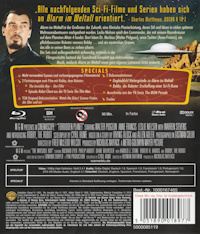  |
|||
|
For the 50th Anniversary of Forbidden Planet in 2006, Warner made a digital restoration on the movie, making the difficult source material look much younger again. It is often erroneously assumed that Forbidden Planet was originally shot in the 2.55:1 CinemaScope ratio, but in 1956, three years after the introduction of the anamorphic widescreen system, everyone had long switched to the now familiar 2.35:1, which is represented in this new transfer as 2.40:1. Arrow’s new 4K transfer brings the aspect ratio to 2.55:1 but judging from a few videos floating around the web it seems to have been achieved by matting the image at the top without actually gaining any width, so this 2010 Blu-Ray might be the more accurate representation. The 2010 Blu-Ray was based on the 2006 digital restoration, but seems to have been slightly improved for the new release. The film source looks remarkably good and noticeably cleaner than on the DVD. There are still some tiny white specks visible, but those are even less noticeable than before. The film grain was again not removed at all and is more or less constantly visible depending on the nature of each scene with special effects sequences looking a little bit more grainy. This way the movie looks refreshingly alive and not like a digtal filtered mess. Sharpness is excellent too, especially for a CinemaScope movie of this age. The detail on the Blu-Ray is also much better, the slightly blurry look from the DVD is not noticeable here at all. Like the grain level, sharpness also varies a little bit depending on the nature of the scene. The colours have been reconstructed as good as possible, almost completely removing the green-yellowish tint some of the earlier transfers were plagued with. Because the 1950s Eastmancolor process is notoriously difficult to colour grade, the success was not quite one hundred percent – sometimes the colour of the grey uniforms suddenly changes a little bit and flesh tones are also not completely constant The typical pastel-like colour timing has still been remarkably well preserved considering the age of the movie. The only visible distraction of the new transfer comes from the source material itself and is not really fixable: most opticals and cross-fades still stand out like sore thumbs especially in high definition because those are at least one dupe generation further away from the master and look accordingly grainier and less detailed. The new restoration has minimized those differences to a certain degree, but without completely re-assembling the movie – which would probably impossible because most of the source material is long gone – this is as good as the movie will ever look. The compression on the Blu-Ray looks concerning at first, because the movie just takes up 18 Gigabytes of the BD-50 that isn’t even used to full capacity. But despite the relatively low bitrate that tops out at just 25 mbit/s there are absolutely no compression artifacts visible and even the fine film grain is reproduced without any problems. While Warner didn’t do a full restoration back in 2010 for the new Blu-Ray, there is actually little to complain about the image quality. |
||||
|
The sound format of the original Forbidden Planet release in 1956 has been the subject of many debates, but the release of the new DVD in 2006 made clear that there were indeed prints with four magnetic tracks in addition to less expensive ones only with optical mono sound with “perspecta” sound steering. The four-track master had already been used for the 2.0 surround track of the previous DVD release, but the new edition features a discrete track sourced from the original mag tracks. On the Blu-Ray, the English track is encoded in DTS HD Master Audio and has, of course, the advantage of not having PAL speedup. The English soundtrack is listed as 5.1, but it seems to be more an adaption of the original magnetic track mix with three front and one rear channel. While Forbidden Planet is certainly a true science-fiction movie, the listener should certainly not expect a modern surround spectacle – but the soundtrack is still surprisingly active and much more than just an enhanced mono. The first surprise is the high directionality of the dialogue, which makes the voices follow the actors on the wide CinemaScope image, reproducing the vintage method of dialogue mixing in full authenticity. The sound effects, consisting in large parts of Louis and Bebe Barron’s “Electronic Tonalities”, are sometimes limited just to the center channel, but often spread out over the frontal soundstage and even use the surrounds on occasion. While spread out a little more, this mix is still very much in the spirit of the 1950s. The overall sound is surprisingly clean and undistorted, with only a slight background hiss, which is preferable to a tinny, filtered soundtrack. Frequency and dynamic range have, of course, age-related limitations, but do not appear overly distracting. Even the sometimes a bit shrill electronic music sounds much less biting and scratchy than on earlier mixes. Even the dialogue has a surprisingly good quality, sounding much less tinny than on many other movies of this age. Unfortunately Warner has made practically no restoration efforts for the German soundtrack. The German version is still somewhat acceptable, but the voices sound extremely thin and exhibit loud hissing on all s-noises, pointing to a badly transferred optical track. The other languages sound even worse. Subtitles are provided in all the languages of the soundtracks. |
||||
|
For the Special Edition of Forbidden Planet, Warner had made a big effort digging up a lot of fascinating and rare material from the archives, some of which had never been seen before. The absence of an audio commentary may be disappointing at first, but the documentaries, featurettes and even deleted scenes more than make up for that – not to mention the inclusion of another whole movie and an episode of a television series. The Blu-Ray menus are different than on the DVD but are still elegant and very much in style. The Blu-Ray has all of the extras together with the movie on one disc. Watch the Skies! Science Fiction, The 1950s and Us (55:31) is an excellent documentary by film historian Richard Schickel about the science fiction wave of the 1950s, originally produced for Turner Classic Movies in 2005. It features filmmakers George Lucas, Steven Spielberg, Ridley Scott und James Cameron reminiscing about the old classics of science fiction and the workings of the film industry. Everyone exhibits an amazing amount of film history knowledge, making this documentary a treasure trove not only for newcomers to the genre. Their appearances are supplemented by generous amounts of film clips and a nicely done voiceover by none other than Mark “Luke Skywalker” Hamill. While this is not the most profound and academic documentary of all times, it celebrates the most important factor of the genre – having fun watching the movies themselves and understanding how the genre developed over time. It’s the perfect documentary for this release. Amazing! Explore the Far Reaches of Forbidden Planet (26:34) was newly produced for the 2006 special edition and despite its short length manages to document the development of the movie in great detail. New interviews with actors Anne Francis, Earl Holliman, Warren Stevens, Richard Anderson, Leslie Lielsen and composer Bebe Barron, as well as Roboter-Designer Robert Kinoshita bring a lot of amazing first-hand accounts of the making of the movie. They are joined by filmmakers John Landis, William Malone, Joe Dante and Joe Carpenter, special effects creators John Dykstra, Phil Tippet and Dennis Muren, authors Alan Dean Foster and Bill Warren, film historians Bob Burns and Rudy Behmler and sound designer Ben Burtt, who are also talking about the history of Forbidden Planet and its influence on the film industry. Robby the Robot: Engineering an Science-Fiction Icon (13:45) takes a look at the electronic star of the movie. Robby’s designer Robert Kinoshita, collector and director William Malone, the owner of the original suit and Fred “The Robot Man” Barton, who constructs life-size Robby replicas, tell all about how the most famous robot in film history was conceived, designed and manufactured. Trailers are only available for Forbidden Planet (3:41) and The Invisible Boy (2:31) on the Blu-Ray. A few trailers for other MGM and Warner movies that were included on the DVD edition are omitted here. Both trailers are presented in 480p only but at least the one for the main feature has a decent quality. The Deleted Scenes (13:13) have been sourced from a workprint, which evidently has only survived as a very fuzzy videotape, but at least the original aspect ratio has been preserved. The terrible quality does not make these scenes any less interesting – some had been entirely removed from the movie for timing reasons, others are extended versions of existing sequences, including the infamous jump cut at the end of the movie. All scenes are introduced by detailed text screens with lots of information. Lost Footage (9:21) consists of eight test sequences from the special effects, which are presented in anamorphic 1.78:1 and look slightly better than the deleted scenes, but are still somewhat scratched and blurry. Unfortunately something seems to be wrong with the aspect ratio – this seems to be a 4:3 image stretched to 16:9, but it is unknown if the test footage was produced in 1.33:1 or if the scenes were pan&scanned from the CinemaScope original. The similarity to existing scenes in the movie sadly suggest the latter, but the scenes are still fascinating to watch. Like the deleted scenes, all sequences are introduced by informative text screens. The Invisible Boy (89:29) is the semi-sequel of Forbidden Planet from 1957, but it mostly amounts to an embarrassment not worthy of a separate release. The movie was mostly made to recoup the enormous construction costs of the robot suit and has no real connection to Forbidden Planet save for Robby himself, so it really feels like a cheap cash-in. Warner has still done a decent anamorphic transfer, albeit without any digital cleanup resulting in a bit more dust and scratches than tolerable – but the quality is still much better than expected for such a curiosity. There is only an English soundtrack – either the movie was never released in Germany or Warner simply didn’t bother to include any dubs – but there are subtitles in English, German, Dutch and Spanish. The quality is basically the same as on the DVD because it’s in standard definition only. The Thin Man: Robot Client (25:35) is a complete episode from the 1958 television series with Robby the Robot as a guest star. While it’s not one of the best examples of 1950s US television, it’s a nice curiosity and the image quality is quite good save for a slight videotape look and occasionally dust and scratches. It is also included only in standard 480p definition. MGM Parade Excerpt from Episode 27 (2:16) and Episode 28 (3:58) are short excerpts from MGM’s television program that was often used as a promotion platform for the studio’s movies – here, Walter Pidgeon is pitching Forbidden Planet to the audience and is even joined by Robby the Robot in the second scene on the spaceship set! |
||||


 The Movie