 2010: The Year We Make Contact |
||||
|
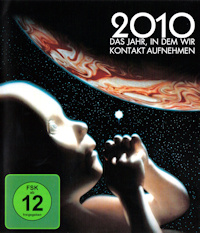
Title | 2010: The Year We Make Contact | ||
| Studio | Metro-Goldwyn-Mayer (1984) | |||
| Released by | Warner Home Video (2009) | |||
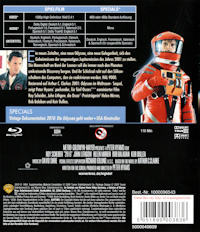
| Disc Type | BD-50 (26.9 GB) | Bitrate | ø 25 max. 30 | |
| Runtime | 115:51 Minutes | Chapter | 32 | |
| Region | ABC (Germany) | Case | Amaray | |
| Format | HD 1080p24 AVC | |||
| Image | 2.35:1 | 16:9 |  |
|
| Sound |  True HD  English English, German, French, Italian, Spanish, Portuguese |
|||
| Subtitles | Englisch, German, French, Italian, Spanish, Portuguese | |||
| Rating | FSK 12 | |||
| Extras | • 2010: The Odyssey Continues – Vintage Documentary • Trailer |
|||
|
It is nine years after the failed Jupiter mission of Discovery, which had cost the lives of four astronauts and saw another mysteriously disappear when encountering a Monolith in orbit around the planet. Both Americans and Russians are preparing for a new mission to the stranded spacecraft. Heywood Floyd, who initiated the first Discovery mission, learns from a Russian informant that time is running out. The Discovery’s orbit has become unstable and the spacecraft is at risk of crashing into Jupiter’s moon Io. Since the Russian mission is set to arrive at Jupiter before the Americans, whose construction of Discovery II has stalled, Floyd negotiates a deal with both governments. He, along with Discovery’s designer, Walter Curnow and Dr. Chandra, the creator of the ship’s computer HAL, will fly on the Russian spacecraft with the chance to finally uncover what caused the 2001 mission to fail. When Stanley Kubrick and Arthur C. Clarke had completed their joint science fiction masterpiece 2001: A Space Odyssey in 1968, there were no plans for a sequel. In fact, Kubrick even had the space ship models destroyed to prevent them from falling into the hands of other filmmakers. However, inspired by the advancements in space exploration since the premiere of 2001, Arthur C. Clarke decided to continue the story in a new novel. 2010: Odyssey Two was published in 1982, and while it wasn’t hailed as a masterpiece like its predecessor, it was recognized as a successful sequel to 2001 and was even nominated for a Hugo Award, which Clarke lost to Isaac Asimov. Metro-Goldwyn-Mayer, the producers of Stanley Kubrick’s 2001, had transformed from a Hollywood giant to a hotel conglomerate with a largely inactive film studio since the late 1960s. Nevertheless, MGM had acquired the film rights to Arthur C. Clarke’s novel and was looking for a filmmaker to take on the project. Stanley Kubrick himself had no interest in a sequel but was not opposed to it either, encouraging Arthur C. Clarke to find another filmmaker for collaboration. MGM was particularly interested in 2010 because the studio was celebrating its 60th anniversary in 1984 and wanted to release something special for the occasion. Filmmaker Peter Hyams had expressed significant interest in 2010 early in the development. With Capricorn One and Outland he had already previously directed two unusual science fiction films in the 1970s and 1980s and had also made a name for himself with war drama Hanover Street and the legal thriller The Star Chamber. Hyams had approached Arthur C. Clarke and Stanley Kubrick, who gave him their blessing for the project. While Kubrick entrusted 2010 entirely to Hyams, Clarke closely collaborated with him, because the director also wrote the screenplay himself. Since Clarke had emigrated to Sri Lanka in the mid-1950s and was reluctant to undertake long journeys, so he and Peter Hyams began communicating via an early incarnation of email to write the script together. Compared to its predecessor, 2010 was a much more conventional science fiction novel than its predecessor. Arthur C. Clarke didn’t even attempt to replicate the mysterious quality of the original but instead loosely continued the previous events. He also provided some answers to unanswered questions from 2001 without imitating or questioning the previous plot. Peter Hyams and Arthur C. Clarke decided to make the film a lot more grounded and bring a plausible science-future story to the screen. The 2010 script had to be streamlined to fit into a two-hour film, as the roadshow format of 2001 with a runtime of more than two hours with an intermission had long since gone out of style and would have been difficult to sell to the studio. The screenplay followed the book closely, but a longer subplot involving a race between the Russian-American mission and the Chinese, whose spaceship lands on Europa and is destroyed by an unknown life form, was omitted from the film for budget and time reasons. Instead, the competition with the Chinese was completely removed in the film, and the Leonov sends a probe to the surface of Europa, which is destroyed just before discovering an unknown life form. The friendly collaboration between Americans and Russians in the novel was replaced in the film with a scenario reminiscent of the Cold War of the 1980s. As the story unfolds, it leads to the Americans moving into the Discovery and severing contact with the Leonov. While Stanley Kubrick made silence a virtue in 2001 and drastically reduced voiceovers and extensive dialogue, 2010 was quite talkative in comparison. Peter Hyams and Arthur C. Clarke agreed that, like in the source material, the story couldn’t be effectively conveyed with minimal dialogue. Therefore, the screenplay included more or less extensive talking, mainly to provide the actors with more to do. In 2001, the story focused on Dave Bowman, Frank Poole, and the computer HAL, while in 2010, Heywood Floyd, one of the supporting characters from the previous film, was elevated to the protagonist. William Sylvester, who had played the role before, was no longer interested, so the character had to be recast. One option considered was Richard Dreyfuss, but he was deemed still too young for the character. Ultimately, Roy Scheider was chosen, as he was a better fit being in his early fifties. Roy Scheider had established himself as a versatile character actor since the early 1970s and had achieved Hollywood success with films like Jaws and All That Jazz. In 2010, he portrayed Heywood Floyd as a sarcastic, mistrustful, and somewhat cynical scientist, effectively developing a character that had previously received little attention. Roy Scheider not only played the role but also narrates the story, serving as a central character who maintains the narrative thread through letters to his family and acquaintances. Arthur C. Clarke originally wanted to cast Ben Kingsley as Dr. Chandra, the creator of HAL, given that the character in the novel was described as of Indian origin. However, Kingsley couldn’t be cast, but since Chandra’s heritage wasn’t mentioned in the film scropt, the role could be cast differently. Peter Hyams chose Bob Balaban, who had previously played a key role in Steven Spielberg’s Close Encounters of the Third Kind. With his calm and deliberate demeanor, Balaban was an ideal fit for the eccentric computer genius. The third of the three American main characters was Discovery engineer Walter Curnow, a character created by Arthur C. Clarke specifically for the novel. For this role, a comedian like Walter Matthau, who had previously demonstrated his versatility as a serious actor, could have been considered. In the end filmmakers chose John Lithgow, who was part of a theater family and had initially studied acting in England. In 2010 Lithgow stood out not only for his height but primarily for his good-natured, humorous demeanor. He also delivered a realistic and dramatic portrayal of a spacewalk. The casting of the Russian astronauts was elegantly handled by primarily choosing Russian actors for the roles. One exception was British actress Helen Mirren, who had Russian ancestry and portrayed Captain Tanya Kirbuk so convincingly that she didn’t seem English at all. Elya Baskin, actually a Latvian-American actor, played the good-natured bear Max Brajlovsky, making him an ideal counterpart to John Lithgow’s Walter Curnow, who share one of the film’s best scenes. Russian comedian Saveliy Kramarov as Dr. Rudenko, and other Russian actors Natasha Shneider, Oleg Rudnik and Vladimir Skomarovsky had limited opportunities to showcase their talents, as their roles remained at the level of background characters. Nevertheless, their presence added a surprising authenticity to the Russian characters, which was a rarity in 1980s films. Two small but crucial roles remained unchanged. Keir Dullea reprised his role as Dave Bowman, who returned after his Character’s mysterious disappearance in the finale of “2001.” He appeared briefly, looking remarkably similar with the help of some advanced makeup. The Canadian actor Douglas Rain also returned as the voice of HAL, the ship’s computer, as no one else could capture the essence of the electronic brain as faithfully as him. Unlike 2001, 2010 was not shot on 65mm film but on conventional 35mm with Panavision lenses to save costs. This choice was also influenced by the significant improvements in film quality since the late 1960s, making the larger format less necessary. The filming took place exclusively in the United States and focused mainly on studio shots, as the story primarily revolved around the space mission. The sets designed by Albert Brenner and Set Decorator Rick Simpson, who had previously worked with Peter Hyams, particularly impressed with their almost sober realism, especially with the interior of the Leonov. Some of the Discovery sets were reconstructed to the best of their ability but were not as elaborately staged as in 2001. Peter Hyams and Arthur C. Clarke initially expected Douglas Trumbull, who had previously worked on the original film, to be in charge of the visual effects of 2010 too. Sadly, due to problems with MGM during the production of his own movie Brainstorm, he recommended his colleague Richard Edlund instead. He had begun his career as a founding member of George Lucas’ Industrial Light and Magic and had taken over Douglas Trumbull’s company, Entertainment Effects, to produce the effects for 2010 and Ghostbusters. During pre-production, Peter Hyams was dismayed to find out that not only did the 15-meter-long model of the Discovery no longer exist, but all construction plans had been destroyed. Richard Edlund and his extensive team at Entertainment Effects faced the challenge of designing a new Russian spaceship and also to create an entirely new model of the Discovery. With no plans or blueprints, the effects specialists had to work with enlargements from 70mm film and photographs, resulting in a new Discovery that didn’t perfectly match the original but was still an impressive and highly detailed model. The design of the Russian spaceship Leonov was a contrast to the sleek and futuristic Discovery. Instead, it resembled a massive factory, but this was not meant to represent the incompetence of the Russian space agency. Instead, it was intended to show their technical superiority. The design resembled the robust Imperial Destroyers in George Lucas’ Star Wars or the Nostromo of Ridley Scott’s Alien without ignoring a certain level of realism. While the majority of the special effects were achieved through traditional model shots, some computer elements were used. To create a realistic representation of Jupiter’s constantly moving atmosphere, the filmmakers turned to Digital Productions, a company known for its pioneering CGI animations in The Last Starfighter. With data provided by the Jet Propulsion Laboratory, a dynamic animation was created. While not an exact representation of the planet’s distinctive cloud cover, it offered impressive realism for an early computer animation. One significant weak point of the film was the music, which almost completely departed from Stanley Kubrick’s original idea of using classical compositions instead of an original score. Richard Strauss’ Also Sprach Zarathustra was used again as the main theme and György Ligeti’s vocal composition Lux Aeterna was also reprised at the beginning. But for the rest of the score, Peter Hyams opted for a soundtrack dominated by synthesizer sounds, in stark contrast to the original. This decision aimed to underline the futuristic atmosphere of the film in a completely different way than 2001. Initially, Tony Banks, the keyboardist for Genesis, was considered due to his pioneering work with synthesizers, but his inexperience in film music led director Peter Hyams to turn to David Shire, a well-established songwriter and film and television composer with a reputation as a skilled pianist and keyboardist. Together with versatile musician Craig Huxley, who had previously contributed to the music of the early Star Trek movies, Shire composed a score that was quite different from the classical sounds of the original. The 2010 score primarily consisted of synthesizer soundscapes with few memorable melodies, serving mainly as atmospheric background music to create a mysterious and somewhat menacing atmosphere in a very different way from 2001. 2010 was completed just in time for Metro-Goldwyn-Mayer’s 60th anniversary celebration and was released in the United States in early December 1984 under the expanded title The Year We Make Contact. There had been concerns and negative feedback long before its release, as it was challenging to envision a worthy sequel to a classic like 2001. However, Arthur C. Clarke and Peter Hyams dispelled these concerns by avoiding the temptation to imitate the original and instead created a completely unique movie. In the end, even the critics had to acknowledge that comparing 2001 and 2010 was unfair due to their completely different styles. Peter Hyams had successfully crafted an excellent science fiction film that treated its predecessor’s legacy with the greatest respect. Even more than a decade after 2010, Peter Hyams and Arthur C. Clarke’s film remains one of the best realistic science fiction movies in film history, second only to its predecessor. In the cinema landscape of the time, which was populated by Star Wars, Star Trek and other space fantasies, 2010 was an exception, much like 2001 had been in the late 1960s. Peter Hyams and Arthur C. Clarke more than managed to fulfill Stanley Kubrick’s wish to create a “proverbial good science-fiction movie”.
2010: The Year We Make Contact was first released in the United States by MGM in 1998, along with its predecessor and an identical DVD was sold by Warner starting in 2000. Warner had acquired the rights to many MGM films and was the first to release the DVD in Europe, even before its predecessor had been released there. However, all of these releases were based on an old, non-anamorphic transfer created in 1997 for a Laserdisc, which had unacceptable picture quality even at the time. While the DVD never got reissued, a Blu-Ray with a new high-definition transfer was finally released in 2009 worldwide. Sadly, there are no elaborate extras, but having the movie in good quality on Blu-Ray is worth the disc alone. |
  |
|||
|
2010: The Year We Make Contact has never been available on DVD with a decent anamorphic transfer but this Blu-Ray issued in 2009 makes more than up for it. The quality can’t quite reach that of its predecessor, but that is understandable since it was “only” shot on 35mm Panavision. Considering the limitations of the film format, this new HD transfer is very nice. The film source has been impeccably cleaned and there is no dirt, scratches or other damage visible at all. Thankfully, the film grain was not touched at all and it is more or less visible depending on the scene. Parts of the movie with low light have very visible grain due to the high iso film used, but on most other scenes the grain is hardly noticeable. The special effects also look relatively clean but the HD transfer sometimes reveals a few imperfections. The image stability is generally good and only wobbles slightly in the special effects sequences, something that is not really the fault of the transfer. The colour reproduction is spectacular and of course a huge improvement over the extremely noisy and mushy earlier versions. Especially the space sequences now look much better and brightness and contrast have been improved a lot – there is no more brightness blooming and the blacks really look dark now. While a full restoration could improve the quality even more, this is a solid transfer and a huge improvement over the terrible older versions. |
||||
|
2010: The Year We Make Contact was originally not only mixed into Dolby Surround but also in multichannel 6-track for the 70mm releases. Those masters were presumably used for the old DVDs and also for the somewhat similar, but slightly improved soundtracks of the Blu-Ray. While the English track is available in both Dolby Digital and True HD 5.1, all other languages have Dolby Digital 5.1 tracks only. The English 5.1 audio track was likely newly mixed again from the 70mm 6-track masters and delivers a reasonably solid sound. The surround mix is actually somewhat reserved and primarily uses the rear channels for music, except for a few appropriate scenes. The slightly muffled quality of the music on the earlier DVDs has been improved a lot and now has decent highs and a solid bass. Even the sound of the voices seems much better with a less tinny and more realistic sound. The dynamic is also much better and makes the soundtrack less loud and more detailed than on the older versions. The German soundtrack and probably all the other dubs seem to be mostly identical to the old mixes and sound much worse than the overhauled English soundtrack. Subtitles are available in all languages of the audio tracks. |
||||
|
Sadly, Warner has never taken the opportunity to produce a proper special edition of 2010, which would have deserved a better treatment. Instead only a vintage featurette and a trailer are presented in the cheap-looking menus. 2010: The Odyssey Continues (9:20) is a promotional featurette produced in 1984 that features Arthur C.Clarke and some of the actors in a very superficial look at the movie’s production. It gives a few glimpses behind the scenes but is not a good substitution for a proper documentary. The Trailer (2:26) is only preserved in 4:3 1.66:1 letterbox and disappointing quality. |
||||


 The Movie

 Image
 Bonus Materials